


Alex
Alex’s Runaway Racer
Alex has built a car with a problem — it has no engine!
Luckily, he has a balloon, a straw and an idea.
Build a balloon-powered racer and discover how escaping air can make a car move. Then become the engineer: change ONE thing, test it again and use your evidence to make Alex’s racer travel even further.
How far can you make it go?

Ages
7-12 yrs
Duration
min
25
Difficulty
Medium
Stage
Stage 2-3
Cite this resource
Created by Darin Carr (BSc, DipEd)
NESA Accredited Teacher · Chemistry & Physics Specialist · 30+ years in-class teaching
Resource Version: 1.0
First Published:
Last Updated:
21 Aug 2026

MISSION VERIFIED
Classroom tested. Teacher designed. Safe at home.

Designed by Darin Carr (BScDip Ed)
Practising NESA accredited
Australian Science Teacher
★ 30+ years of classroom experience
MISSION PROGRESS
young scientists have completed this mission.
I'VE COMPLETED THIS MISSION
Click to let us know you have completed this mission
LATEST TEACHER FEEDBACK
No feedback yet for this experiment. Use it with your class and let us know how it went!

Before you investigate... watch the mystery
MISSION HOOK
Professor Picklebottom and the team are travelling and collecting amazing science mysteries.
✔ Coming in Term 1 2027

KEEP EXPLORING
Curiosity Files
BIG Questions & Discovery
Illustrated Facts
Explore • Discover
Road Trip Science
Discover science everywhere
The Teacher's Cauldron
Think. Experiment. Inspire
Books
Read • Explore
Videos
Watch & Learn
LAB Resources
Premium learning resources

Mission Equipment
Gather your materials and get
ready for an amazing mission!
1 rectangle of firm cardboard
4 plastic wheels
2 axles, 1 balloon
2 drinking straws for axle guides
1 drinking straw for the balloon
Sticky tape, Scissors
Measuring tape
Rubber bands for investigating wheel traction
Small masses/coins for investigating mass (optional)


Let’s Investigate
Follow the missions steps below to solve the mystery.
1
Build the Body

Cut a rectangle of firm cardboard for your racer.
TIP: Start with a simple rectangle. You'll get a chance to improve your design later.
PREDICT
OBSERVE
EVIDENCE
ASK
SAFETY
TIP
PREDICT
Gather your materials and get
ready for an amazing mission!
2
Add the Axle Guides

Cut two pieces of straw slightly wider than the cardboard.
Tape one underneath near the front and one near the back.
TIP: Don't squash the straws with the tape. Your axles need to spin freely inside them.
PREDICT
OBSERVE
EVIDENCE
ASK
SAFETY
TIP
PREDICT
Gather your materials and get
ready for an amazing mission!
3
Add the Wheels

Slide an axle through each straw and push a blue wheel onto each end.
TIP: Leave a tiny gap between each wheel and the cardboard.
PREDICT
OBSERVE
EVIDENCE
ASK
SAFETY
TIP
PREDICT
Gather your materials and get
ready for an amazing mission!
4
Make the Balloon Engine

Stretch the neck of the balloon securely over one end of the long straw.
PREDICT
OBSERVE
EVIDENCE
ASK
SAFETY
TIP
PREDICT
Gather your materials and get
ready for an amazing mission!
5
Finish Your Racer

Tape the long straw along the top of your racer with the open end pointing out behind the car.
TIP: Make sure the balloon and straw aren't touching the wheels.
PREDICT
OBSERVE
EVIDENCE
ASK
SAFETY
TIP
PREDICT
Gather your materials and get
ready for an amazing mission!
6
Test Your Racer

Mark a starting line. Inflate your balloon, place the racer behind the line and release it without pushing.
Measure how far it travels.
Repeat your test 3 times.
PREDICT
OBSERVE
EVIDENCE
ASK
SAFETY
TIP
PREDICT
Gather your materials and get
ready for an amazing mission!
7
Can You Make It Go Further?

Now become the engineer!
Choose ONE thing to change that you think could make Alex's racer travel further.
Add rubber bands to the wheels for more traction
Change the amount of air in the balloon
Add some mass to the racer
TIP: Change only ONE thing. Keep everything else as similar as possible.
PREDICT
OBSERVE
EVIDENCE
ASK
SAFETY
TIP
PREDICT
Gather your materials and get
ready for an amazing mission!
8
Test Your New Design

Make your change and test the racer another 3 times.
Use the same starting line and measure the distance each time.
PREDICT
OBSERVE
EVIDENCE
ASK
SAFETY
TIP
PREDICT
Gather your materials and get
ready for an amazing mission!
9
What Did You Discover?
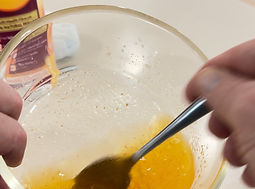
Look at all your results. Did your change improve Alex's racer?
Complete:
I discovered that changing __________ made the racer __________.
What measurements support your conclusion?
PREDICT
OBSERVE
EVIDENCE
ASK
SAFETY
TIP
PREDICT
1
Build the Body
Gather your materials and get
ready for an amazing mission!
PREDICT
OBSERVE
EVIDENCE
ASK
SAFETY
TIP
PREDICT
1
Build the Body
Gather your materials and get
ready for an amazing mission!
PREDICT
OBSERVE
EVIDENCE
ASK
SAFETY
TIP
PREDICT
1
Big Title
Gather your materials and get
ready for an amazing mission!
PREDICT
OBSERVE
EVIDENCE
ASK
SAFETY
TIP
PREDICT
The Crazy Scientist LAB Learning System™
Every experiment follows The Crazy Scientist Lab Learning System™ — a simple way to help kids think like real scientists.
We
-
LINK to what they already know,
-
ACTIVATE curiosity through hands-on discovery
-
BUILD understanding that actually sticks.

Cars usually need an engine, motor or someone pushing them. But Alex’s racer has none of these!
Its only power source is a balloon filled with air.
Before you release it, predict what will happen. Which direction will the air move? Which direction will the car move?
Then comes the bigger challenge: how far can you make it travel?

Start with the basic racer and give it a test run.
Mark the starting line, release the car and measure how far it travels.
Try it several times. Does it travel about the same distance each time?
Now look closely at your racer. Are the wheels spinning freely? Is it travelling straight? Are the wheels slipping?
Your first tests are your baseline. You'll use them to decide whether your modifications actually improve the racer.

Escaping air creates the force that sends your racer moving.
The stretched balloon pushes air backwards through the straw. The escaping air pushes back on the balloon — and the car moves in the opposite direction.
This is called action and reaction and is described by Newton's Third Law of Motion.
But air power isn't the only thing affecting your racer. Friction, wheel alignment, mass and traction can all change how efficiently it moves.
That's why engineers don't just build something once.
"Want the full teacher guide? The Crazy Scientist Lab includes classroom delivery tips, how to manage the WOW moment, differentiation for Stage 2 & 3, — ready to teach tomorrow."
Think Like a Scientist
Scientists don't stop after their first discovery.
They ask new questions, collect more evidence and test their ideas in different ways.
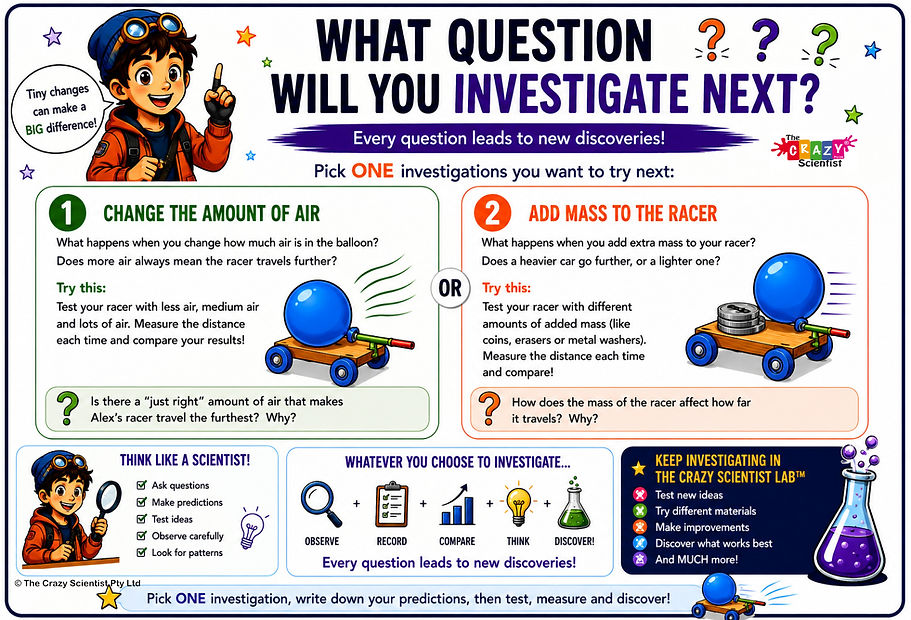
Where could you take this investigation next?
What happens to the distance travelled if you add rubber bands around the wheels to increase traction?
What happens if you change how much air is inside the balloon?

Dr Puddledrip’s Science Tip

Read the Science
Why did the racer move?
When you released the balloon, air rushed backwards through the straw.
Pushing the air backwards created a force in the opposite direction, pushing the car forwards.
This is called Newton’s Third Law of Motion — forces come in pairs.
The balloon pushes the air backwards, and the air pushes the racer forwards.
Where did the racer get its energy?
Blowing up the balloon stretches the rubber and stores elastic potential energy.
When you let go, the balloon contracts and forces the air out. Some of that stored energy is transferred into the movement of the car.
A bigger balloon may store more energy — but does that always mean the racer will travel further?
That’s something you can test!
Why do the wheels and axles matter?
The wheels need to turn freely so the racer can keep moving.
Friction between the axles and other parts of the car can resist motion and slow it down. If an axle rubs, bends or isn't straight, some of the balloon's energy is wasted overcoming that friction.
But friction can also be useful. The wheels need enough traction with the floor to roll without slipping.
Can you make the racer travel further?
Absolutely!
Try changing one thing at a time — the amount of air in the balloon, the mass of the car, the wheel traction or even the direction of the straw.
Measure how far the racer travels and compare your results.
A small change could send Alex’s racer much further!
And there’s even more science hiding inside your runaway racer...
Teachers & Homeschoolers: Print-ready HD versions of this Science Behind It poster and companion G&T Challenge Card are available inside The Crazy Scientist LAB.
Scientist's Challenge
Designed for HPGE, gifted learners and children who enjoy an extra challenge.

Teachers & Homeschoolers: Print-ready HD versions of this Science Behind It poster and companion G&T Challenge Card are available inside The Crazy Scientist LAB.
The Next Question...
You've solved today's mystery. Now discover where curiosity can take you next.
Teachers & Homeschoolers: Print-ready HD versions of this Science Behind It poster and companion G&T Challenge Card are available inside The Crazy Scientist LAB.
Vocabulary
Thrust — a force that pushes something forwards.
Friction — a force that resists movement when surfaces rub together.
Traction — the grip between the wheels and the ground.
Know a parent or teacher who'd love this? Send it on! 👇
Keep Exploring This Mystery
One experiment leads to even more amazing discoveries inside the Learning Universe.
Curiosity Files
BIG Questions & Discovery
Illustrated Facts
Explore • Discover
Road Trip Science
Discover science everywhere
The Teacher's Cauldron
Think. Experiment. Inspire
Books
Read • Explore
Videos
Watch & Learn
LAB Resources
Premium learning resources
Ready for Your Next Discovery?


READY TO TEACH THIS
TOMORROW?

Running the experiment is easy; however, teaching it well is another challenge.
Teachers often ask:
How do I adapt this for Stages 1,2 or 3?
What misconceptions will they have?
What syllabus outcomes does it cover?
What do I do with fast finishers?
How do I structure this for a full class?
What do I say when they ask WHY?
BUILD AROUND THE LAB LEARNING SYSTEM™
Every resource is designed using our teaching framework.

Inside The Crazy Scientist LAB
Everything you need to confidently teach science tomorrow.


Opening early 2027. Join the Founding Member Waitlist
More Ways to Explore The Crazy Scientist World
Discover more hands-on science fun, programs and resources for every curious mind.


