


Alex
Scribble Bot Challenge
This robot has a problem.
It has no wheels.
No legs.
No steering.
And definitely no brain!
So it shouldn't be able to go anywhere...
But switch on one tiny motor and suddenly it starts wobbling, spinning and scribbling its way across the page.
Something is turning that tiny vibration into movement.
But here's the really interesting part...
Can YOU change its design and control where it goes?

Ages
7-12 yrs
Duration
min
30
Difficulty
Medium
Stage
Stage 2-3
Cite this resource
Created by Darin Carr (BSc, DipEd)
NESA Accredited Teacher · Chemistry & Physics Specialist · 30+ years in-class teaching
Resource Version: 1.0
First Published:
Last Updated:
23 Aug 2026

MISSION VERIFIED
Classroom tested. Teacher designed. Safe at home.

Designed by Darin Carr (BScDip Ed)
Practising NESA accredited
Australian Science Teacher
★ 30+ years of classroom experience
MISSION PROGRESS
1
young scientists have completed this mission.
I'VE COMPLETED THIS MISSION
Click to let us know you have completed this mission
LATEST TEACHER FEEDBACK
No feedback yet for this experiment. Use it with your class and let us know how it went!

Before you investigate... watch the mystery
MISSION HOOK
Professor Picklebottom and the team are travelling and collecting amazing science mysteries.
✔ Coming in Term 1 2027

KEEP EXPLORING
Curiosity Files
BIG Questions & Discovery
Illustrated Facts
Explore • Discover
Road Trip Science
Discover science everywhere
The Teacher's Cauldron
Think. Experiment. Inspire
Books
Read • Explore
Videos
Watch & Learn
LAB Resources
Premium learning resources

Mission Equipment
Gather your materials and get
ready for an amazing mission!
Pool noodle,
3 coloured textas,
small motor,
AAA battery holder, AAA battery,
double-sided tape,
paddle-pop sticks,
pipe cleaners,
sticky eyes, large paper


Let’s Investigate
Follow the missions steps below to solve the mystery.
1
Big Title
Gather your materials and get
ready for an amazing mission!
PREDICT
OBSERVE
EVIDENCE
ASK
SAFETY
TIP
PREDICT
Gather your materials and get
ready for an amazing mission!
1
Big Title
Gather your materials and get
ready for an amazing mission!
PREDICT
OBSERVE
EVIDENCE
ASK
SAFETY
TIP
PREDICT
Gather your materials and get
ready for an amazing mission!
1
Big Title
Gather your materials and get
ready for an amazing mission!
PREDICT
OBSERVE
EVIDENCE
ASK
SAFETY
TIP
PREDICT
Gather your materials and get
ready for an amazing mission!
1
Big Title
Gather your materials and get
ready for an amazing mission!
PREDICT
OBSERVE
EVIDENCE
ASK
SAFETY
TIP
PREDICT
Gather your materials and get
ready for an amazing mission!
1
Big Title
Gather your materials and get
ready for an amazing mission!
PREDICT
OBSERVE
EVIDENCE
ASK
SAFETY
TIP
PREDICT
Gather your materials and get
ready for an amazing mission!
1
Big Title
Gather your materials and get
ready for an amazing mission!
PREDICT
OBSERVE
EVIDENCE
ASK
SAFETY
TIP
PREDICT
Gather your materials and get
ready for an amazing mission!
1
Big Title
Gather your materials and get
ready for an amazing mission!
PREDICT
OBSERVE
EVIDENCE
ASK
SAFETY
TIP
PREDICT
Gather your materials and get
ready for an amazing mission!
1
Big Title
Gather your materials and get
ready for an amazing mission!
PREDICT
OBSERVE
EVIDENCE
ASK
SAFETY
TIP
PREDICT
Gather your materials and get
ready for an amazing mission!
1
Big Title
Gather your materials and get
ready for an amazing mission!
PREDICT
OBSERVE
EVIDENCE
ASK
SAFETY
TIP
PREDICT
1
Build Your Scribble Bot
Gather your materials and get
ready for an amazing mission!
PREDICT
OBSERVE
EVIDENCE
ASK
SAFETY
TIP
PREDICT
1
Build Your Scribble Bot
Gather your materials and get
ready for an amazing mission!
PREDICT
OBSERVE
EVIDENCE
ASK
SAFETY
TIP
PREDICT
1
Big Title
Gather your materials and get
ready for an amazing mission!
PREDICT
OBSERVE
EVIDENCE
ASK
SAFETY
TIP
PREDICT
The Crazy Scientist LAB Learning System™
Every experiment follows The Crazy Scientist Lab Learning System™ — a simple way to help kids think like real scientists.
We
-
LINK to what they already know,
-
ACTIVATE curiosity through hands-on discovery
-
BUILD understanding that actually sticks.

Connect this investigation to what you already know.
Have you ever felt a mobile phone, electric toothbrush or game controller vibrate in your hand?
Inside these devices, something is moving very quickly and making the whole object shake.
You may also have noticed that vibrating objects can sometimes buzz, creep or move across a hard surface.
But here's today's mystery...
Your Scribble Bot has no wheels, no walking legs and no steering.
Yet when its tiny motor starts spinning, the whole robot can wobble, turn and travel across the paper.
Before you investigate, make your prediction.
What do you think will happen when you switch on the motor and let go of your Scribble Bot? Why do you think it will move that way?

Use your observations to build your ideas.
You switched on your Scribble Bot and watched the colourful trail it left behind. Now think carefully about what you observed.
Did your bot stay in one place, or did it travel across the paper?
Did it move smoothly, or did it shake and wobble as it moved?
Did it mostly travel forwards, spin around, or keep changing direction?
What happened when you changed the angle of the textas?
Did changing the design also change the scribble pattern it produced?
What do you think the spinning motor has to do with the movement you observed?
Look closely at the scribbles your bot left behind.
Use those lines as evidence to explain how your Scribble Bot was moving.

Take your thinking further.
You discovered that a spinning motor can make your Scribble Bot vibrate, and those vibrations can produce movement when the textas push against the paper.
Engineers use vibration in some surprising ways:
Making phones and game controllers buzz to give us alerts and feedback.
Creating rapid movement in electric toothbrushes.
Using vibrating machines to move and sort small objects in factories.
Designing tiny vibrating robots that can move without wheels.
Using vibration to help settle materials such as concrete.
But vibration isn't always useful. Engineers also have to stop unwanted vibrations in cars, machines, buildings and bridges.
Your Scribble Bot shows that changing the position of its parts can change how vibration affects its movement.
"Want the full teacher guide? The Crazy Scientist Lab includes classroom delivery tips, how to manage the WOW moment, differentiation for Stage 2 & 3, — ready to teach tomorrow."
Think Like a Scientist
Scientists don't stop after their first discovery.
They ask new questions, collect more evidence and test their ideas in different ways.
Where could you take this investigation next?
Change the angle of the textas. Try them straight, slightly angled and widely angled. How does this change the way your Scribble Bot moves?
Move the motor to a different position. Try it near the centre and then closer to one side. What happens to the Scribble Bot's movement?

Dr Puddledrip’s Science Tip

Read the Science
Why does the Scribble Bot move?
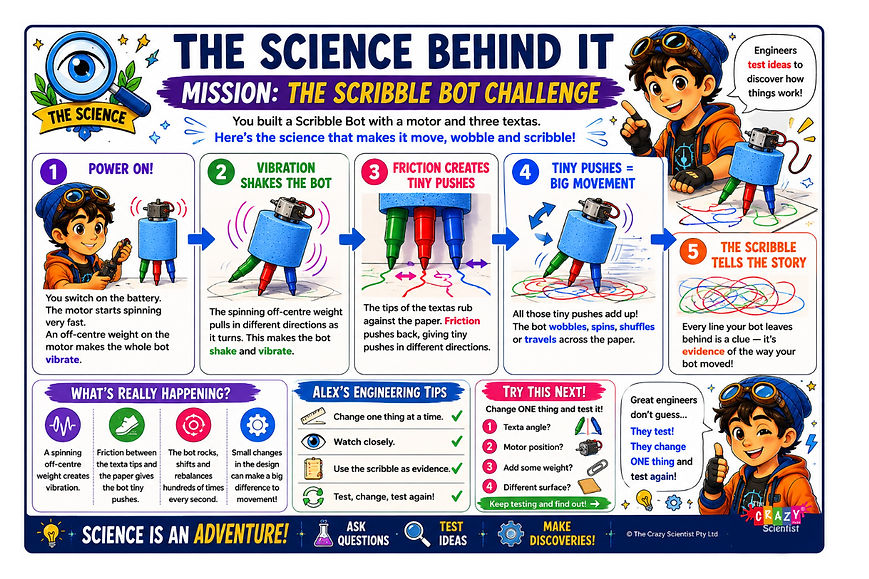
Your Scribble Bot doesn't have wheels, muscles or even a brain. Its movement starts with the tiny electric motor.
When electricity from the battery reaches the motor, the motor's shaft spins very quickly.
Attached to the shaft is a small weight that is off-centre — one side is heavier than the other.
As this uneven weight spins around, it continually pulls the motor in different directions.
Those tiny movements travel through the body of the Scribble Bot, making the whole robot vibrate.
You can feel the same kind of idea when a mobile phone buzzes in your hand.
But vibration is only the beginning. Your Scribble Bot still needs something to turn all that shaking into movement across the paper.
What do the textas have to do with it?
The tips of the textas are touching the paper, and that creates friction.
Friction is a force that acts when two surfaces rub or try to slide across each other.
As the Scribble Bot vibrates:
the texta tips push against the paper
friction resists their movement
the bot rocks and shifts slightly
these tiny movements happen again and again, very quickly
Put them together and your Scribble Bot can wobble, shuffle, spin or travel across the page.
And because the textas are touching the paper, they leave behind a colourful record of that movement — the scribble!
Why does changing the textas change the scribble?
Your three textas aren't just drawing tools. They're also the Scribble Bot's legs.
Changing their angle changes how the robot stands and how the texta tips interact with the paper.
Try making the legs wider, narrower, straighter or more angled and you may change:
how stable the bot is
how easily it rocks
the direction it moves
how much it spins
the pattern it draws
That's why two Scribble Bots made from exactly the same materials might create completely different drawings.
Small design changes can produce surprisingly big changes in movement.
Why does the position of the motor matter?
The motor is the source of the vibration, but where you put it can matter too.
Place the motor near the centre and its vibrations act on the robot differently than when the motor is moved towards one side.
An off-centre motor can make one part of the bot shake differently from another. Combined with the position of the textas and the bot's weight, this can change whether your Scribble Bot tends to spin, wobble or travel.
This is why engineers test different designs instead of assuming their first idea will work best.
Build. Test. Observe. Change. Test again.
That's engineering!
Teachers & Homeschoolers: Print-ready HD versions of this Science Behind It poster and companion G&T Challenge Card are available inside The Crazy Scientist LAB.
Scientist's Challenge
Designed for HPGE, gifted learners and children who enjoy an extra challenge.
Teachers & Homeschoolers: Print-ready HD versions of this Science Behind It poster and companion G&T Challenge Card are available inside The Crazy Scientist LAB.
The Next Question...
You've solved today's mystery. Now discover where curiosity can take you next.

Teachers & Homeschoolers: Print-ready HD versions of this Science Behind It poster and companion G&T Challenge Card are available inside The Crazy Scientist LAB.
Vocabulary
Vibration — A quick back-and-forth movement or shaking.
Friction — A force that resists movement when two surfaces rub against each other.
Force — A push or pull that can change how something moves.
Know a parent or teacher who'd love this? Send it on! 👇
Keep Exploring This Mystery
One experiment leads to even more amazing discoveries inside the Learning Universe.
Curiosity Files
BIG Questions & Discovery
Illustrated Facts
Explore • Discover
Road Trip Science
Discover science everywhere
The Teacher's Cauldron
Think. Experiment. Inspire
Books
Read • Explore
Videos
Watch & Learn
LAB Resources
Premium learning resources


- Coming Mid 2027
The Question Grenade: 5 Questions That Can Change an Investigation
Ready for Your Next Discovery?


READY TO TEACH THIS
TOMORROW?

Running the experiment is easy; however, teaching it well is another challenge.
Teachers often ask:
How do I adapt this for Stages 1,2 or 3?
What misconceptions will they have?
What syllabus outcomes does it cover?
What do I do with fast finishers?
How do I structure this for a full class?
What do I say when they ask WHY?
BUILD AROUND THE LAB LEARNING SYSTEM™
Every resource is designed using our teaching framework.

Inside The Crazy Scientist LAB
Everything you need to confidently teach science tomorrow.


Opening early 2027. Join the Founding Member Waitlist
More Ways to Explore The Crazy Scientist World
Discover more hands-on science fun, programs and resources for every curious mind.


