


Mackey
Tutankhamun's Mystery Powders
While exploring Tutankhamun's tomb, archaeologists discovered four mysterious jars filled with unknown powders.
Were they medicines? Crushed plants? Ancient make-up? Precious minerals?
Scientists don't guess—they collect clues.
Join Macky as you investigate each mystery sample using careful observations and simple scientific tests.
Can you gather enough evidence to identify which powders may have once come from living things and which are minerals?

Ages
9-12 yrs
Duration
min
15
Difficulty
Medium
Stage
Stage 2-3
Cite this resource
Created by Darin Carr (BSc, DipEd)
NESA Accredited Teacher · Chemistry & Physics Specialist · 30+ years in-class teaching
Resource Version: 1.0
First Published:
Last Updated:
15 July 2026
24 Aug 2026

MISSION VERIFIED
Classroom tested. Teacher designed. Safe at home.

Designed by Darin Carr (BScDip Ed)
Practising NESA accredited
Australian Science Teacher
★ 30+ years of classroom experience
MISSION PROGRESS
young scientists have completed this mission.
I'VE COMPLETED THIS MISSION
Click to let us know you have completed this mission
LATEST TEACHER FEEDBACK
No feedback yet for this experiment. Use it with your class and let us know how it went!

Before you investigate... watch the mystery
MISSION HOOK
Professor Picklebottom and the team are travelling and collecting amazing science mysteries.
✔ Coming in Term 1 2027

KEEP EXPLORING
Curiosity Files
BIG Questions & Discovery
Illustrated Facts
Explore • Discover
Road Trip Science
Discover science everywhere
The Teacher's Cauldron
Think. Experiment. Inspire
Books
Read • Explore
Videos
Watch & Learn
LAB Resources
Premium learning resources

Mission Equipment
Gather your materials and get
ready for an amazing mission!
4 small clear cups or containers
Plain flour
Table salt
Bicarbonate of soda
Dried yeast
Warm water
White vinegar
Sugar
4 teaspoons
Magnifying glass (optional)
Paper towel
Safety glasses


Let’s Investigate
Follow the missions steps below to solve the mystery.
1
Explore the Mystery Powders

Place the same amount (about 1 teaspoon) of each mystery powder into four labelled clear cups (A–D).
Do not mix the powders together.
PREDICT
OBSERVE
EVIDENCE
ASK
SAFETY
TIP
PREDICT
Gather your materials and get
ready for an amazing mission!
2
The Water Test

Water often reveals hidden clues.
Add 2 tablespoons of warm water to each cup.
Stir each sample using a clean spoon.
Watch carefully.
PREDICT
OBSERVE
EVIDENCE
ASK
SAFETY
TIP
PREDICT
Gather your materials and get
ready for an amazing mission!
3
The Vinegar Test

Some minerals react with weak acids.
Rinse the cups, dry them, and add new dry powder into the test cups.
Add 1 teaspoon of vinegar to each mystery powder.
Observe.
PREDICT
OBSERVE
EVIDENCE
ASK
SAFETY
TIP
PREDICT
Gather your materials and get
ready for an amazing mission!
4
Yeast Test

Again, rinse, dry and get a new sample of each powder.
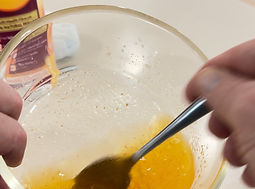
Mix warm water with one teaspoon of sugar.
Now test each mystery powder.
Add one spoonful.
Stir gently.
Wait 5–10 minutes.
Which sample starts producing bubbles?
PREDICT
OBSERVE
EVIDENCE
ASK
SAFETY
TIP
PREDICT
Gather your materials and get
ready for an amazing mission!
5
Compare Your Evidence

Look back at all your results.
Compare:
observations
water test
vinegar test
yeast test
Which clues helped you the most?
PREDICT
OBSERVE
EVIDENCE
ASK
SAFETY
TIP
PREDICT
Gather your materials and get
ready for an amazing mission!
6
Compare Your Clues

You've collected all your evidence.
Now compare your results with the Archaeologist's Reference Guide. (below in the Science Behind It section).
PREDICT
OBSERVE
EVIDENCE
ASK
SAFETY
TIP
PREDICT
Gather your materials and get
ready for an amazing mission!
1
Big Title
Gather your materials and get
ready for an amazing mission!
PREDICT
OBSERVE
EVIDENCE
ASK
SAFETY
TIP
PREDICT
Gather your materials and get
ready for an amazing mission!
1
Big Title
Gather your materials and get
ready for an amazing mission!
PREDICT
OBSERVE
EVIDENCE
ASK
SAFETY
TIP
PREDICT
Gather your materials and get
ready for an amazing mission!
1
Big Title
Gather your materials and get
ready for an amazing mission!
PREDICT
OBSERVE
EVIDENCE
ASK
SAFETY
TIP
PREDICT
Which one do you think came from something that was once alive?
Which do you think is a mineral?
Record your predictions.
1
Explore the Mystery Powders
Gather your materials and get
ready for an amazing mission!
PREDICT
OBSERVE
EVIDENCE
ASK
SAFETY
TIP
PREDICT
Which one do you think came from something that was once alive?
Which do you think is a mineral?
Record your predictions.
1
Explore the Mystery Powders
Gather your materials and get
ready for an amazing mission!
PREDICT
OBSERVE
EVIDENCE
ASK
SAFETY
TIP
PREDICT
Which one do you think came from something that was once alive?
Which do you think is a mineral?
Record your predictions.
1
Big Title
Gather your materials and get
ready for an amazing mission!
PREDICT
OBSERVE
EVIDENCE
ASK
SAFETY
TIP
PREDICT
Which one do you think came from something that was once alive?
Which do you think is a mineral?
Record your predictions.
The Crazy Scientist LAB Learning System™
Every experiment follows The Crazy Scientist Lab Learning System™ — a simple way to help kids think like real scientists.
We
-
LINK to what they already know,
-
ACTIVATE curiosity through hands-on discovery
-
BUILD understanding that actually sticks.

Have you ever found something mysterious?
Maybe an unusual rock, an old coin, a strange seed or an unknown powder.
If you discovered a mysterious jar inside a 3,000-year-old Egyptian tomb, how would you know what it contained?
Scientists don't guess.
They observe, test and collect evidence before making a conclusion.
Today, you'll become an archaeological science detective.

Before anyone tells you the answers...
You'll investigate four mystery powders from Tutankhamun's tomb.
As you work, remember one important question:
Could this powder have once been part of a living thing?
You'll gather clues by:
making careful observations
comparing the powders
carrying out simple scientific tests
recording your evidence
Every clue brings you one step closer to solving the mystery.

You solved the mystery by collecting evidence just like a real archaeologist.
But how do scientists decide whether something is alive—or once came from a living thing?
They use a checklist called MRS GREN.
Living things show these life processes:
Movement
Respiration
Sensitivity
Growth
Reproduction
Excretion
Nutrition
Not every test is possible with ancient materials, but scientists look for clues that these life processes once occurred.
In today's investigation, the yeast became active when you added warm water and sugar. That was evidence it was made of tiny living organisms.
The other powders behaved differently because they were minerals or materials that no longer carry out the life processes of living things.
The important lesson?
Scientists don't decide by appearance alone—they collect evidence and compare it with what they already know about living things.
"Want the full teacher guide? The Crazy Scientist Lab includes classroom delivery tips, how to manage the WOW moment, differentiation for Stage 2 & 3, — ready to teach tomorrow."
Think Like a Scientist
Scientists don't stop after their first discovery.
They ask new questions, collect more evidence and test their ideas in different ways.
Where could you take this investigation next?
Does the type of liquid used affect the results you observe? (lemon juice, salt water etc)
Does using more powder make it easier to identify the mystery?
Dr Puddledrip’s Science Tip

Read the Science
How Did Ancient Egyptians Identify Mystery Powders?
Thousands of years ago, the ancient Egyptians didn't have microscopes, chemical laboratories or computers. Yet they still worked with dozens of different powders every day. Some were used to make medicines. Others became make-up, paint or building materials. Some were even used during the mummification process.
So how did they know which powder they were holding?
Just like real scientists today, they started by making careful observations.
Scientists Always Look for Clues First
Imagine someone gave you four white powders with no labels.
Could you tell the difference?
At first they might all look almost the same. But if you slow down and observe carefully, you'll start noticing clues.
Scientists compare things like:
colour
texture
crystal shape
smell (when safe)
how the powder feels
what happens when water is added
Every observation helps narrow down the possibilities. Ancient healers became incredibly skilled at spotting these tiny differences long before modern science existed.
Some Powders React in Different Ways
Looking isn't always enough.
Some powders only reveal their identity when you test them.
When scientists mix different materials together they watch carefully for evidence.
Questions they might ask include:
Does it fizz?
Does it dissolve?
Does it become sticky?
Does it change colour?
Does it release a gas?
Each result is another clue that helps identify an unknown substance.
In today's experiment you discovered that different powders behave very differently, even when
they look almost identical.
Yeast Is Alive!
One of the biggest surprises is that yeast isn't just another powder.
Yeast is actually a living fungus made from millions of tiny cells.
When yeast is given:
water
warmth
sugar
it begins carrying out the life processes that all living things perform. As it feeds, it releases carbon dioxide gas, creating the bubbles you observed during the investigation.
This simple test is one way scientists can tell that yeast is very different from baking soda, flour or salt.
Teachers & Homeschoolers: Print-ready HD versions of this Science Behind It poster and companion G&T Challenge Card are available inside The Crazy Scientist LAB.
Scientist's Challenge
Designed for HPGE, gifted learners and children who enjoy an extra challenge.

Teachers & Homeschoolers: Print-ready HD versions of this Science Behind It poster and companion G&T Challenge Card are available inside The Crazy Scientist LAB.
The Next Question...
You've solved today's mystery. Now discover where curiosity can take you next.
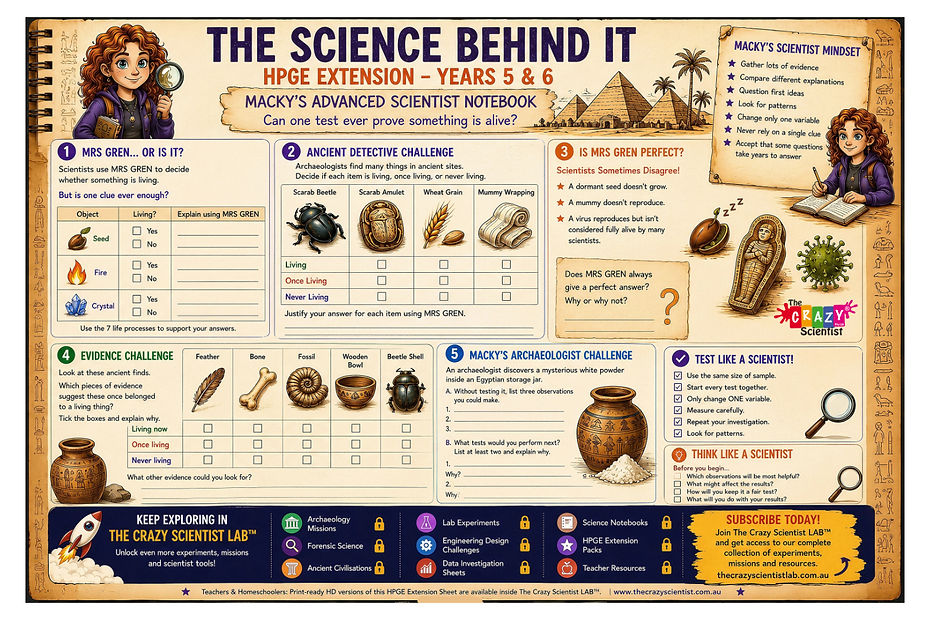
Teachers & Homeschoolers: Print-ready HD versions of this Science Behind It poster and companion G&T Challenge Card are available inside The Crazy Scientist LAB.
Vocabulary
Classification
Sorting objects or organisms into groups based on their features.
Organism
A living thing that carries out the life processes in MRS GREN.
Evidence
Observations and test results that help scientists make a conclusion instead of guessing.
Know a parent or teacher who'd love this? Send it on! 👇
Keep Exploring This Mystery
One experiment leads to even more amazing discoveries inside the Learning Universe.
Curiosity Files
BIG Questions & Discovery
Illustrated Facts
Explore • Discover
Road Trip Science
Discover science everywhere
The Teacher's Cauldron
Think. Experiment. Inspire
Books
Read • Explore
Videos
Watch & Learn
LAB Resources
Premium learning resources


- Coming Early 2027
What Were the Mysterious Powders Hidden Inside Tutankhamun's Tomb?
- Coming Early 2027
Could You Read a Secret Message Written 3,000 Years Ago?
Ready for Your Next Discovery?


READY TO TEACH THIS
TOMORROW?

Running the experiment is easy; however, teaching it well is another challenge.
Teachers often ask:
How do I adapt this for Stages 1,2 or 3?
What misconceptions will they have?
What syllabus outcomes does it cover?
What do I do with fast finishers?
How do I structure this for a full class?
What do I say when they ask WHY?
BUILD AROUND THE LAB LEARNING SYSTEM™
Every resource is designed using our teaching framework.

Inside The Crazy Scientist LAB
Everything you need to confidently teach science tomorrow.


Opening early 2027. Join the Founding Member Waitlist
More Ways to Explore The Crazy Scientist World
Discover more hands-on science fun, programs and resources for every curious mind.


