


Professor Picklebottom
Water Balloon Timebomb
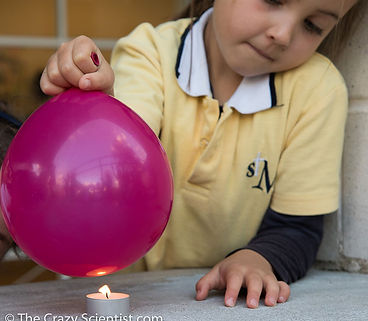
Hold a water balloon directly over a candle flame. It should pop any second now. Any second. But it doesn't. Hold an air balloon over the same flame and it goes in an instant. Same balloon. Same flame. So why does one survive?
Ages
9-12 yrs
Duration
min
10
Difficulty
Easy
Stage
Stage 3
Cite this resource
Created by Darin Carr (BSc, DipEd)
NESA Accredited Teacher · Chemistry & Physics Specialist · 30+ years in-class teaching
Resource Version: 1.0
First Published:
Last Updated:
4 Mar 2023
21 Aug 2026

MISSION VERIFIED
Classroom tested. Teacher designed. Safe at home.

Designed by Darin Carr (BScDip Ed)
Practising NESA accredited
Australian Science Teacher
★ 30+ years of classroom experience
MISSION PROGRESS
38
young scientists have completed this mission.
I'VE COMPLETED THIS MISSION
Click to let us know you have completed this mission
LATEST TEACHER FEEDBACK
No feedback yet for this experiment. Use it with your class and let us know how it went!

Before you investigate... watch the mystery
MISSION HOOK
Professor Picklebottom and the team are travelling and collecting amazing science mysteries.
✔ Coming in Term 1 2027

KEEP EXPLORING
Curiosity Files
BIG Questions & Discovery
Illustrated Facts
Explore • Discover
Road Trip Science
Discover science everywhere
The Teacher's Cauldron
Think. Experiment. Inspire
Books
Read • Explore
Videos
Watch & Learn
LAB Resources
Premium learning resources

Mission Equipment
Gather your materials and get
ready for an amazing mission!
· 2 balloons
· Water (about 1 cup)
· 1 tealight candle
· Lighter or matches (adult use only)
· A tray (to catch any drips)


Let’s Investigate
Follow the missions steps below to solve the mystery.
1
Prepare the balloons

Fill one balloon with about 50mL of water, then tie it off — it will look like a round water bomb. Blow up the second balloon with air and tie it off to the same size.
Teacher Tip: The water balloon works best when it's fairly full — too little water and it won't absorb enough heat. A balloon about the size of a large orange is ideal.
PREDICT
OBSERVE
EVIDENCE
ASK
SAFETY
TIP
PREDICT
Gather your materials and get
ready for an amazing mission!
2
Light the candle

Place your tealight on a tray and light it. Let the flame settle for 30 seconds until it's burning steadily. Adult to light the candle — students observe.
PREDICT
OBSERVE
EVIDENCE
ASK
SAFETY
TIP
PREDICT
Gather your materials and get
ready for an amazing mission!
3
Test the air balloon first

Hold the air-filled balloon about 5 cm above the candle flame and start counting. How long before it pops? Make a prediction first — then try it!
PREDICT
OBSERVE
EVIDENCE
ASK
SAFETY
TIP
PREDICT
Gather your materials and get
ready for an amazing mission!
4
Now try the timebomb!

Hold the water balloon directly over the flame — even touching it. Keep it there! Keep counting. Watch what happens to the flame underneath.
PREDICT
OBSERVE
EVIDENCE
ASK
SAFETY
TIP
PREDICT
Gather your materials and get
ready for an amazing mission!
5
Inspect the evidence

Lift the water balloon away from the flame and look at the bottom. What do you see? There's a black soot mark — proof the flame was real — but the balloon survived. Why?
PREDICT
OBSERVE
EVIDENCE
ASK
SAFETY
TIP
PREDICT
Gather your materials and get
ready for an amazing mission!
1
Big Title
Gather your materials and get
ready for an amazing mission!
PREDICT
OBSERVE
EVIDENCE
ASK
SAFETY
TIP
PREDICT
Gather your materials and get
ready for an amazing mission!
1
Big Title
Gather your materials and get
ready for an amazing mission!
PREDICT
OBSERVE
EVIDENCE
ASK
SAFETY
TIP
PREDICT
Gather your materials and get
ready for an amazing mission!
1
Big Title
Gather your materials and get
ready for an amazing mission!
PREDICT
OBSERVE
EVIDENCE
ASK
SAFETY
TIP
PREDICT
Gather your materials and get
ready for an amazing mission!
1
Big Title
Gather your materials and get
ready for an amazing mission!
PREDICT
OBSERVE
EVIDENCE
ASK
SAFETY
TIP
PREDICT
1
Prepare the balloons
Gather your materials and get
ready for an amazing mission!
PREDICT
OBSERVE
EVIDENCE
ASK
SAFETY
TIP
PREDICT
1
Prepare the balloons
Gather your materials and get
ready for an amazing mission!
PREDICT
OBSERVE
EVIDENCE
ASK
SAFETY
TIP
PREDICT
1
Big Title
Gather your materials and get
ready for an amazing mission!
PREDICT
OBSERVE
EVIDENCE
ASK
SAFETY
TIP
PREDICT
The Crazy Scientist LAB Learning System™
Every experiment follows The Crazy Scientist Lab Learning System™ — a simple way to help kids think like real scientists.
We
-
LINK to what they already know,
-
ACTIVATE curiosity through hands-on discovery
-
BUILD understanding that actually sticks.

You already know what happens when a balloon gets too close to a candle flame — it pops. Fast. Every single time, no exceptions.
So here's the challenge: what if you held a water balloon directly over the flame and it just… didn't pop? Make your prediction. How long do you think it could last before it goes off?

• Hold an air-filled balloon near the flame. Start counting. (Stand back — it won't last long!)
• Now fill a balloon with water and hold it directly over the same flame. Keep it there. Keep counting.
👉 Why did the air balloon pop so fast when the water balloon just sat there?
👉 Look at the bottom of the water balloon — what did the flame leave behind?
👉 What do you think stopped the rubber from melting?

• Heat from the candle travels through the rubber and straight into the water — that's called heat transfer
• Water needs an enormous amount of energy to heat up — far more than rubber or air
• The heat keeps moving from the rubber into the water, so the rubber never gets hot enough to melt
👉 Think of it like a sponge — the water inside the balloon soaks up heat energy the same way a sponge soaks up a spill, before the surface beneath ever gets wet
• This is why firefighters use water to fight fires, why you sweat when you're hot, and why oceans keep coastal cities cool
Where else does water's ability to absorb heat keep something — or someone — safe?
"Want the full teacher guide? The Crazy Scientist Lab includes classroom delivery tips, how to manage the WOW moment, differentiation for Stage 2 & 3, — ready to teach tomorrow."
Think Like a Scientist
Scientists don't stop after their first discovery.
They ask new questions, collect more evidence and test their ideas in different ways.
Where could you take this investigation next?
What happens if you use warm water instead of cold?
What happens if you use less water — how little can you get away with before it pops?

Dr Puddledrip’s Science Tip
Read the Science
When the candle flame heats the bottom of the balloon, that heat travels through the rubber and straight into the water inside — that movement of heat is called conduction.
Here's the key: water needs an enormous amount of energy to heat up. Far more than rubber, far more than air. Scientists call this specific heat capacity — water's superpower for soaking up heat.
So the heat from the flame keeps moving from the rubber straight into the water, and the rubber never gets a chance to reach the temperature it needs to melt. The water is always one step ahead, draining the energy away.
Think of it like:
• A thin metal spoon left in hot soup heats up almost instantly — there's barely anything there to absorb the energy
• A full pot of water on the same stove takes ages to boil — it's soaking up enormous amounts of heat
• Your water balloon works exactly like that pot — the water inside keeps draining the heat away from the rubber
The soot mark on the bottom is proof the flame was real. The rubber just never got hot enough to care.
Curiosity spark: What do you think would happen if you used less water? Is there a point where the balloon finally runs out of room to absorb the heat?
🔬 Find out in The Crazy Scientist Lab.
Teachers & Homeschoolers: Print-ready HD versions of this Science Behind It poster and companion G&T Challenge Card are available inside The Crazy Scientist LAB.
Scientist's Challenge
Designed for HPGE, gifted learners and children who enjoy an extra challenge.

Teachers & Homeschoolers: Print-ready HD versions of this Science Behind It poster and companion G&T Challenge Card are available inside The Crazy Scientist LAB.
The Next Question...
You've solved today's mystery. Now discover where curiosity can take you next.
Teachers & Homeschoolers: Print-ready HD versions of this Science Behind It poster and companion G&T Challenge Card are available inside The Crazy Scientist LAB.
Vocabulary
Heat Transfer — The movement of thermal energy from a warmer object to a cooler one.
Thermal Energy — Energy associated with the movement of particles in matter.
Conduction — The transfer of heat through direct contact.
Know a parent or teacher who'd love this? Send it on! 👇
Keep Exploring This Mystery
One experiment leads to even more amazing discoveries inside the Learning Universe.
Curiosity Files
BIG Questions & Discovery
Illustrated Facts
Explore • Discover
Road Trip Science
Discover science everywhere
The Teacher's Cauldron
Think. Experiment. Inspire
Books
Read • Explore
Videos
Watch & Learn
LAB Resources
Premium learning resources
Ready for Your Next Discovery?


READY TO TEACH THIS
TOMORROW?

Running the experiment is easy; however, teaching it well is another challenge.
Teachers often ask:
How do I adapt this for Stages 1,2 or 3?
What misconceptions will they have?
What syllabus outcomes does it cover?
What do I do with fast finishers?
How do I structure this for a full class?
What do I say when they ask WHY?
BUILD AROUND THE LAB LEARNING SYSTEM™
Every resource is designed using our teaching framework.

Inside The Crazy Scientist LAB
Everything you need to confidently teach science tomorrow.


Opening early 2027. Join the Founding Member Waitlist
More Ways to Explore The Crazy Scientist World
Discover more hands-on science fun, programs and resources for every curious mind.


