


Essy
Drink Up
Essy has a new mystery from the her dinner table (with parents permission of course)
She’s watching a candle, a pool of water and an upside-down glass very carefully. Something unusual is about to happen… but what?
Make your prediction, then investigate!

Ages
7-12 yrs
Duration
min
5
Difficulty
Easy
Stage
Stage 3
Cite this resource
Created by Darin Carr (BSc, DipEd)
NESA Accredited Teacher · Chemistry & Physics Specialist · 30+ years in-class teaching
Resource Version: 1.0
First Published:
Last Updated:
8 June 2026
9 Aug 2026

MISSION VERIFIED
Classroom tested. Teacher designed. Safe at home.

Designed by Darin Carr (BScDip Ed)
Practising NESA accredited
Australian Science Teacher
★ 30+ years of classroom experience
MISSION PROGRESS
6
young scientists have completed this mission.
I'VE COMPLETED THIS MISSION
Click to let us know you have completed this mission
LATEST TEACHER FEEDBACK
No feedback yet for this experiment. Use it with your class and let us know how it went!

Before you investigate... watch the mystery
MISSION HOOK
Professor Picklebottom and the team are travelling and collecting amazing science mysteries.
✔ Coming in Term 1 2027

KEEP EXPLORING
Curiosity Files
BIG Questions & Discovery
Illustrated Facts
Explore • Discover
Road Trip Science
Discover science everywhere
The Teacher's Cauldron
Think. Experiment. Inspire
Books
Read • Explore
Videos
Watch & Learn
LAB Resources
Premium learning resources

Mission Equipment
Gather your materials and get
ready for an amazing mission!
A shallow plate or wide dish
Water
A birthday candle or small tea light
Blu-tack or a small lump of modelling clay
A clear drinking glass or tall jar
Food colouring
Matches (adult use only)


Let’s Investigate
Follow the missions steps below to solve the mystery.
1
Set up the plate

Pour water into your shallow plate — about 1 to 2 cm deep. Add a few drops of food colouring and stir gently.
Press your birthday candle into a small lump of blu-tack and stand it upright in the centre of the plate.
PREDICT
OBSERVE
EVIDENCE
ASK
SAFETY
TIP
PREDICT
Gather your materials and get
ready for an amazing mission!
2
Make your prediction

Look carefully at the candle, water and empty glass.
Soon, the glass will be lowered over the burning candle.
What do you predict will happen to the water inside the glass after the flame goes out?
Will it rise, fall or stay where it is?
PREDICT
OBSERVE
EVIDENCE
ASK
SAFETY
TIP
PREDICT
Gather your materials and get
ready for an amazing mission!
3
Light the candle
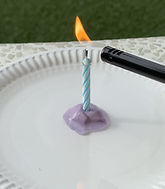
Ask an adult to light the candle.
Let it burn for about 10–15 seconds before moving to the next step.
While you wait, watch the flame carefully.
PREDICT
OBSERVE
EVIDENCE
ASK
SAFETY
TIP
PREDICT
Gather your materials and get
ready for an amazing mission!
4
Lower the glass

Ask an adult to carefully lower the glass straight down over the candle until its rim sits flat against the plate.
Watch the bottom edge of the glass as it comes down.
Can you spot any tiny bubbles escaping?
PREDICT
OBSERVE
EVIDENCE
ASK
SAFETY
TIP
PREDICT
Gather your materials and get
ready for an amazing mission!
5
Watch Carefully

Keep your eyes on the water inside the glass.
Watch what happens when the flame becomes smaller and finally goes out.
Does the water begin moving immediately, or does it take a moment?
PREDICT
OBSERVE
EVIDENCE
ASK
SAFETY
TIP
PREDICT
Gather your materials and get
ready for an amazing mission!
1
Big Title
Gather your materials and get
ready for an amazing mission!
PREDICT
OBSERVE
EVIDENCE
ASK
SAFETY
TIP
PREDICT
Gather your materials and get
ready for an amazing mission!
1
Big Title
Gather your materials and get
ready for an amazing mission!
PREDICT
OBSERVE
EVIDENCE
ASK
SAFETY
TIP
PREDICT
Gather your materials and get
ready for an amazing mission!
1
Big Title
Gather your materials and get
ready for an amazing mission!
PREDICT
OBSERVE
EVIDENCE
ASK
SAFETY
TIP
PREDICT
Gather your materials and get
ready for an amazing mission!
1
Big Title
Gather your materials and get
ready for an amazing mission!
PREDICT
OBSERVE
EVIDENCE
ASK
SAFETY
TIP
PREDICT
1
Set up the plate
Gather your materials and get
ready for an amazing mission!
PREDICT
OBSERVE
EVIDENCE
ASK
SAFETY
TIP
PREDICT
1
Set up the plate
Gather your materials and get
ready for an amazing mission!
PREDICT
OBSERVE
EVIDENCE
ASK
SAFETY
TIP
PREDICT
1
Big Title
Gather your materials and get
ready for an amazing mission!
PREDICT
OBSERVE
EVIDENCE
ASK
SAFETY
TIP
PREDICT
The Crazy Scientist LAB Learning System™
Every experiment follows The Crazy Scientist Lab Learning System™ — a simple way to help kids think like real scientists.
We
-
LINK to what they already know,
-
ACTIVATE curiosity through hands-on discovery
-
BUILD understanding that actually sticks.

You already know fire needs air to burn. Leave a candle burning in a closed space long enough — and it goes out.
Here's your prediction before you touch anything: if you lower a glass over a lit candle sitting in a plate of water, and the flame goes out — what do you think will happen to the water?
Write it down. Up? Down? Nothing? There's a reason this experiment has surprised people for hundreds of years.

Watch the moment the glass touches the plate — look for tiny bubbles escaping out the bottom before the seal forms
Focus on the water inside the glass as the flame goes out — how fast does it move?
Most people think the flame "uses up the oxygen" and that pulls the water in. But the water starts rising almost instantly when the flame goes out — does that match an explanation about oxygen running out slowly?
You can see bubbles leaving the glass just before it seals. Where did that air go — and what filled the space?
What do you think would happen if you used a taller glass — would more water rise, less, or the same amount?

As conditions inside the glass change, the air pressure inside becomes lower than the atmospheric pressure outside. The greater pressure outside pushes water underneath the glass and up into it.
A suction cup on a smooth wall holds by the same principle — how is sticking a suction cup to a window the same idea as what just happened inside your glass?
When you squeeze a dropper, release it underwater, and it draws liquid in — which part of this experiment does that remind you of?
Weather systems work the same way — low pressure pulls air in, high pressure pushes it out. Which one would your glass be, right after the flame goes out?
Where else in everyday life is invisible air pressure doing the heavy lifting — without you ever noticing?
"Want the full teacher guide? The Crazy Scientist Lab includes classroom delivery tips, how to manage the WOW moment, differentiation for Stage 2 & 3, — ready to teach tomorrow."
Think Like a Scientist
Scientists don't stop after their first discovery.
They ask new questions, collect more evidence and test their ideas in different ways.
Where could you take this investigation next?
Does the height of the glass change how much water rises — does a taller glass produce a bigger effect?
Does using more candles change how high the water rises, or how quickly it happens?
Dr Puddledrip’s Science Tip
Read the Science
Why Did the Water Rise?
It can look as though the glass is somehow sucking the water upwards.
But the glass isn't pulling the water in.
The answer involves something we cannot see — air pressure.
What Happens to the Air?
While the candle is burning, it heats the air trapped inside the glass.
Warm air expands, and some of it can escape underneath the edge of the glass. You may even have spotted tiny bubbles escaping as you lowered it.
After the flame goes out, the air inside begins to cool.
Cooling air takes up less space, and water vapour produced by the flame can also condense into liquid water. Together, these changes cause the pressure inside the glass to decrease.
So What Pushes the Water Up?
The air outside the glass is still pushing down on the water with atmospheric pressure.
Now the pressure outside is greater than the pressure inside the glass.
That pressure difference pushes water underneath the rim and up into the glass until the pressures become more balanced.
So the glass doesn't really “drink” the water at all.
The surrounding air pushes it in.
Scientists Say…
Air may be invisible, but it has mass and exerts pressure.
When the pressure on two sides of something is different, air pressure can produce surprisingly large forces.
The same big idea helps explain suction cups, drinking straws, syringes and even some weather patterns.
Curiosity Spark
Would a taller glass make the water rise higher?
What about using two candles instead of one?
Make a prediction before you test it.
Try these
Teachers & Homeschoolers: Print-ready HD versions of this Science Behind It poster and companion G&T Challenge Card are available inside The Crazy Scientist LAB.
Scientist's Challenge
Designed for HPGE, gifted learners and children who enjoy an extra challenge.

Teachers & Homeschoolers: Print-ready HD versions of this Science Behind It poster and companion G&T Challenge Card are available inside The Crazy Scientist LAB.
The Next Question...
You've solved today's mystery. Now discover where curiosity can take you next.

Teachers & Homeschoolers: Print-ready HD versions of this Science Behind It poster and companion G&T Challenge Card are available inside The Crazy Scientist LAB.
Vocabulary
Air Pressure — The force made when air pushes against a surface.
Atmospheric Pressure — The pressure caused by the air surrounding Earth pushing on everything around us.
Expand — To become larger or take up more space, like air does when it is heated.
Know a parent or teacher who'd love this? Send it on! 👇
Keep Exploring This Mystery
One experiment leads to even more amazing discoveries inside the Learning Universe.
Curiosity Files
BIG Questions & Discovery
Illustrated Facts
Explore • Discover
Road Trip Science
Discover science everywhere
The Teacher's Cauldron
Think. Experiment. Inspire
Books
Read • Explore
Videos
Watch & Learn
LAB Resources
Premium learning resources


- Coming Mid 2027
How Can Water Be Hotter Than 350°C Without Boiling?
- Coming Early 2027
Why Doesn't a Deep-Sea Fish Get Squashed?
- Coming Early 2027
Why Don’t Aeroplane Windows Explode?
Ready for Your Next Discovery?


READY TO TEACH THIS
TOMORROW?

Running the experiment is easy; however, teaching it well is another challenge.
Teachers often ask:
How do I adapt this for Stages 1,2 or 3?
What misconceptions will they have?
What syllabus outcomes does it cover?
What do I do with fast finishers?
How do I structure this for a full class?
What do I say when they ask WHY?
BUILD AROUND THE LAB LEARNING SYSTEM™
Every resource is designed using our teaching framework.

Inside The Crazy Scientist LAB
Everything you need to confidently teach science tomorrow.


Opening early 2027. Join the Founding Member Waitlist
More Ways to Explore The Crazy Scientist World
Discover more hands-on science fun, programs and resources for every curious mind.


