
Survival Science - The Plant's Secret Weapon

Alex

Mission Briefing.
Slip a plastic bag over a leafy branch, seal it tight, and leave it in the sun. A few hours later — water appears inside a bag that started completely dry. Where did it come from?
7-12 yrs
10
min
Easy
Stage 2, Stage 3
Designed by Darin Carr (BSc, DipEd)
NESA Accredited Teacher · Chemistry & Physics Specialist · 30+ years in-class teaching
Creator of the LAB™ Learning System
Last updated: June 2026 ·
[Cite this resource ↗]
>
Survival Science - The Plant's Secret Weapon
-
NESA Accredited Teacher
-
High school chemistry & physics specialist 30+ years
-
The Crazy Scientist in primary schools — 15 years
-
International conference presenter on science education
-
Creator of the LAB™ Learning System
-
Curriculum aligned: NSW Science & Technology K–6 (2024)
A picture is worth a thousand words — check this out and see if you can spot the science hiding in plain sight.
Mission Equipment
1 leafy plant (indoor houseplant or outdoor bush/tree branch)
1 clear plastic bag (sandwich bag or ziplock)
1 rubber band or twist tie
A kitchen measuring cup or jug (with mL markings)
String or masking tape (optional — for extra seal)

Let’s Investigate
1
Choose your plant
Pick a healthy, leafy plant — a leafy indoor houseplant or an outdoor bush or tree works perfectly.
The more leaves you can fit inside your bag, the better your result.
3
Check your starting point
Before you walk away, look inside the bag. Is it completely clear and dry? Good — you're ready.

5
Collect & Measure
Carefully peel off the rubber band and remove the bag over your measuring cup.
Tilt the bag so all the collected water runs into the cup, then read the measurement.
Even 1–2 mL means the experiment worked perfectly — that water came entirely from inside the plant.

2
Set. the trap!
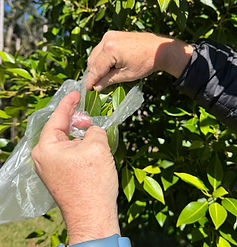
Slip your clear plastic bag over a cluster of leaves — aim for as many leaves as will comfortably fit.
Push the bag down so the leaves sit deep inside, then squeeze the open end around the stem and seal it tight with your rubber band
4
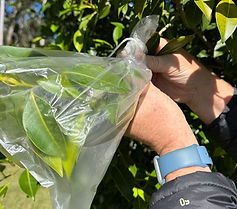
Leave it in the sun
Put your plant in a sunny spot and leave the bag on for at least 2 hours.
Outdoors in direct sunlight gives the fastest and most dramatic result.

Did it work? Share the science! Tag @the_crazy_scientist on Instagram — we love seeing your experiments!
The Crazy Scientist LAB Learning System™
Every experiment follows The Crazy Scientist Lab Learning System™ — a simple way to help kids think like real scientists.
We
-
LINK to what they already know,
-
ACTIVATE curiosity through hands-on discovery
-
BUILD understanding that actually sticks.

You already know plants need water to survive — you water them, they grow, easy. But here's something almost nobody knows:
plants don't just drink water. They release it. Every single day, through millions of tiny holes you can't even see.
Here's the challenge: can you catch the water that your plant is secretly releasing — using nothing but a plastic bag?
Make your prediction.
How much water do you think your plant will release in two hours?

The bag was sealed the whole time — so where did the water come from? Nothing could get in from outside.
Do you think a plant with more leaves would give you more water, or the same amount? What's your reasoning?
If you hadn't put the bag there, where would that water have ended up?x

Plants release water through tiny holes in their leaves — that's called transpiration.
You're stranded on a deserted island. A person needs about 2 litres of water per day to survive. How many bags, on how many plants, would you need to stay alive?
Why would a leafy tree in full sunlight give you more water than the same tree in deep shade?
On a hot, humid day the air feels heavy with moisture — how does transpiration from millions of plants connect to that feeling?
"Want the full teacher guide? The Crazy Scientist Lab includes classroom delivery tips, how to manage the WOW moment, differentiation for Stage 2 & 3, — ready to teach tomorrow."
Think Like a Scientist
Scientists don't just do ONE experiment; they change one part of the experiment (independent variable) and then see how it affects another part of the experiment
(dependent variable)
Change ONE variable and test again.
What happens if you put your bag in full sunlight instead of shade — does the plant release more water?
What happens if you use a plant with bigger, broader leaves — does leaf size change how much water you collect?
🧪 Try it! Change ONE thing and test again. What did you discover?

Dr Puddledrip’s Science Tip
Want to go deeper? Tap a section below to explore. ▼
The Science Behind It
Every leaf on every plant is covered in thousands of tiny pores called stomata — far too small to see without a microscope, but they're there on almost every leaf.
When you sealed the bag around the leaves, any water vapour from the plant leaf had nowhere to go. It hit the cooler surface of the plastic and turned back into liquid water — the same process that makes a cold glass go wet on the outside on a hot day.
That change from vapour back to liquid is called condensation.
Here's the survival science — and this part is real:
In wilderness survival situations, people wrap clear bags around leafy branches in full sun to collect clean, drinkable water. It's called a transpiration bag, and survival guides teach it as a genuine emergency water-collection technique. You just built one.
Think of it like this: every time you walk past a garden on a hot day and feel that cool, slightly humid air — that's transpiration at work. The plants are sharing their water with the atmosphere.
Curiosity spark: Scientists estimate the Amazon rainforest releases about 20 billion tonnes of water into the atmosphere every single day through transpiration. That water forms clouds, falls as rain, and keeps the entire region alive.
What do you think happens to the rainforest's climate if the trees are cut down?
Teachers & Homeschoolers: Print-ready HD versions of this Science Behind It poster and companion G&T Challenge Card are available inside The Crazy Scientist LAB.
Extension: G&T Years 5 & 6
Teachers & Homeschoolers: Print-ready HD versions of this Science Behind It poster and companion G&T Challenge Card are available inside The Crazy Scientist LAB.
Vocabulary
Know a parent or teacher who'd love this? Send it on! 👇

READY TO TEACH THIS
TOMORROW?

Running the experiment is easy; however, teaching it well is another challenge.
Teachers often ask:
How do I adapt this for Stages 1,2 or 3?
What do I do with fast finishers?
What misconceptions will they have?
How do I structure this for a full class?
What syllabus outcomes does it cover?
What do I say when they ask WHY?
BUILD AROUND THE LAB LEARNING SYSTEM™
Every resource is designed using our teaching framework.

Inside The Crazy Scientist LAB
Everything you need to confidently teach science tomorrow.


Opening early 2027. Join the Founding Member Waitlist

Try Another Crazy Experiment
Keep the science going with these fun experiments
Let's Go!
Keep exploring with The Crazy Scientist


Hands-On Science Workshops
Interactive STEM experiences aligned to the NSW syllabus.
