


Mackey
The Imposter
Two glasses. Same water. Same egg. Drop it in the first — it sinks. Drop it in the second — it floats. The glasses look identical. One of them is lying.

Ages
5-12 yrs
Duration
min
15
Difficulty
Easy
Stage
Stage 1-3
Cite this resource
Created by Darin Carr (BSc, DipEd)
NESA Accredited Teacher · Chemistry & Physics Specialist · 30+ years in-class teaching
Resource Version: 1.0
First Published:
Last Updated:
6 Apr 2026
21 Aug 2026

MISSION VERIFIED
Classroom tested. Teacher designed. Safe at home.

Designed by Darin Carr (BScDip Ed)
Practising NESA accredited
Australian Science Teacher
★ 30+ years of classroom experience
MISSION PROGRESS
12
young scientists have completed this mission.
I'VE COMPLETED THIS MISSION
Click to let us know you have completed this mission
LATEST TEACHER FEEDBACK
No feedback yet for this experiment. Use it with your class and let us know how it went!

Before you investigate... watch the mystery
MISSION HOOK
Professor Picklebottom and the team are travelling and collecting amazing science mysteries.
✔ Coming in Term 1 2027
KEEP EXPLORING
Curiosity Files
BIG Questions & Discovery
Illustrated Facts
Explore • Discover
Road Trip Science
Discover science everywhere
The Teacher's Cauldron
Think. Experiment. Inspire
Books
Read • Explore
Videos
Watch & Learn
LAB Resources
Premium learning resources

Mission Equipment
Gather your materials and get
ready for an amazing mission!
2 tall clear glasses
Water
Salt — you'll need a lot
A spoon or stirrer
1 raw egg

Let’s Investigate
Follow the missions steps below to solve the mystery.
1
Set up the glasses

Fill both tall glasses with the same amount of water — about three-quarters full. T
hey must look identical.
Place them side by side. This is your line-up. One is about to become the imposter.
PREDICT
OBSERVE
EVIDENCE
ASK
SAFETY
TIP
PREDICT
Gather your materials and get
ready for an amazing mission!
2
Make the Imposter

Into one glass only, add 6 to 8 tablespoons of salt.
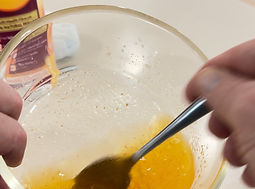
Stir vigorously until it has completely dissolved and the water looks clear again.
The imposter is ready — and it looks exactly like the innocent glass next to it.
PREDICT
OBSERVE
EVIDENCE
ASK
SAFETY
TIP
PREDICT
Gather your materials and get
ready for an amazing mission!
3
Make your prediction

Before the egg goes anywhere: look at both glasses.
They look identical.
You're about to drop the same egg into each one. What do you think will happen — same result in both?
PREDICT
OBSERVE
EVIDENCE
ASK
SAFETY
TIP
PREDICT
Gather your materials and get
ready for an amazing mission!
4
Test the Egg

Gently lower the egg into the plain water glass first.
Watch what happens.
Then carefully lift it out, dry it gently, and lower it into the salt water glass. Watch what happens.
PREDICT
OBSERVE
EVIDENCE
ASK
SAFETY
TIP
PREDICT
Gather your materials and get
ready for an amazing mission!
5
Push it under

With the egg floating in the salt water, use your finger to push it gently below the surface and release it.
What happens?
Try the same thing in the plain water — push the sunken egg down further, then let go.
What happens there?
PREDICT
OBSERVE
EVIDENCE
ASK
SAFETY
TIP
PREDICT
Gather your materials and get
ready for an amazing mission!
1
Big Title
Gather your materials and get
ready for an amazing mission!
PREDICT
OBSERVE
EVIDENCE
ASK
SAFETY
TIP
PREDICT
Gather your materials and get
ready for an amazing mission!
1
Big Title
Gather your materials and get
ready for an amazing mission!
PREDICT
OBSERVE
EVIDENCE
ASK
SAFETY
TIP
PREDICT
Gather your materials and get
ready for an amazing mission!
1
Big Title
Gather your materials and get
ready for an amazing mission!
PREDICT
OBSERVE
EVIDENCE
ASK
SAFETY
TIP
PREDICT
Gather your materials and get
ready for an amazing mission!
1
Big Title
Gather your materials and get
ready for an amazing mission!
PREDICT
OBSERVE
EVIDENCE
ASK
SAFETY
TIP
PREDICT
1
Set up the glasses
Gather your materials and get
ready for an amazing mission!
PREDICT
OBSERVE
EVIDENCE
ASK
SAFETY
TIP
PREDICT
1
Set up the glasses
Gather your materials and get
ready for an amazing mission!
PREDICT
OBSERVE
EVIDENCE
ASK
SAFETY
TIP
PREDICT
1
Big Title
Gather your materials and get
ready for an amazing mission!
PREDICT
OBSERVE
EVIDENCE
ASK
SAFETY
TIP
PREDICT
The Crazy Scientist LAB Learning System™
Every experiment follows The Crazy Scientist Lab Learning System™ — a simple way to help kids think like real scientists.
We
-
LINK to what they already know,
-
ACTIVATE curiosity through hands-on discovery
-
BUILD understanding that actually sticks.

A ship made of steel weighs thousands of tonnes — and floats. A small pebble weighs almost nothing — and sinks. Floating isn't about how heavy something is.
Here's your prediction before you touch anything: you have two glasses of water and one raw egg. You're going to drop the egg into each glass. What do you think will happen — and if the result is different each time, what could possibly explain it? The glasses look identical.
Write it down. You're about to catch an imposter.

Test the egg in the plain water first — watch it sink, then try pushing it down and letting go
Now test the egg in the salt water — notice how high it sits, and try pushing it under and releasing
Both glasses of water look the same from the outside. What is actually different about them — and why does that change what the egg does?
When you pushed the egg down in the salt water and let go, what happened? What does that tell you about the force the water is pushing back with?
The more salt you dissolve, the higher the egg floats. What do you think you're actually changing about the water when you add salt?

Salt dissolved in water adds mass without adding much volume — making the water denser. Denser water pushes back harder. When it pushes harder than the egg weighs, the egg floats.
👉 The Dead Sea has so much dissolved salt that people float on the surface without swimming — what does that tell you about how much salt changes water's density?
Where else in everyday life does density determine whether something sinks, floats — or hovers in between?
"Want the full teacher guide? The Crazy Scientist Lab includes classroom delivery tips, how to manage the WOW moment, differentiation for Stage 2 & 3, — ready to teach tomorrow."
Think Like a Scientist
Scientists don't stop after their first discovery.
They ask new questions, collect more evidence and test their ideas in different ways.
Where could you take this investigation next?
Does the amount of salt change how high the egg floats — is there a minimum amount needed before it floats at all?
Does the size of the egg change how much salt you need — does a larger egg need denser water to float?
Dr Puddledrip’s Science Tip
Read the Science
Same egg. Same glass. One sinks. One floats. Nothing about the egg changed — but the water is keeping a secret.
Floating is about density — how much mass is packed into a given space. A raw egg is slightly denser than fresh water, so when you drop it in, the water can't push back hard enough to support it. It sinks.
Dissolve salt into the water and something quiet happens. You're adding mass without adding much volume — the water gets heavier without getting much bigger. Its density creeps upward. And as density increases, so does the force the water pushes back with — what scientists call buoyancy.
Add enough salt and the water becomes denser than the egg. Now the push-back force is greater than the egg's weight — and up it goes. The egg didn't change. You changed the rules.
Did you notice the egg seems to float at a very specific level rather than just bobbing on top? It's finding its exact density match — the point where the push-back force equals its weight precisely. Move it higher and it sinks back. Push it lower and it rises again.
You can see the same average density principle doing something even more counterintuitive with an orange in [The Life Jacket], and watch salt change a potato's fate entirely in [Sink or Float?].
What would happen if you made a glass of very salty water and carefully poured fresh water on top — could you get the egg to float perfectly in the middle, suspended between two layers?
Find out in The Crazy Scientist Lab.
Teachers & Homeschoolers: Print-ready HD versions of this Science Behind It poster and companion G&T Challenge Card are available inside The Crazy Scientist LAB.
Scientist's Challenge
Designed for HPGE, gifted learners and children who enjoy an extra challenge.
Teachers & Homeschoolers: Print-ready HD versions of this Science Behind It poster and companion G&T Challenge Card are available inside The Crazy Scientist LAB.
The Next Question...
You've solved today's mystery. Now discover where curiosity can take you next.
Teachers & Homeschoolers: Print-ready HD versions of this Science Behind It poster and companion G&T Challenge Card are available inside The Crazy Scientist LAB.
Vocabulary
Density — How much mass is packed into a certain volume.
Float — To stay at or near the surface of a liquid.
Buoyancy — The upward force a liquid exerts on an object.
Know a parent or teacher who'd love this? Send it on! 👇
Keep Exploring This Mystery
One experiment leads to even more amazing discoveries inside the Learning Universe.
Curiosity Files
BIG Questions & Discovery
Illustrated Facts
Explore • Discover
Road Trip Science
Discover science everywhere
The Teacher's Cauldron
Think. Experiment. Inspire
Books
Read • Explore
Videos
Watch & Learn
LAB Resources
Premium learning resources


- Coming Late 2027
Why Does a Yellow Taxi Sometimes Look Green?
Ready for Your Next Discovery?


READY TO TEACH THIS
TOMORROW?

Running the experiment is easy; however, teaching it well is another challenge.
Teachers often ask:
How do I adapt this for Stages 1,2 or 3?
What misconceptions will they have?
What syllabus outcomes does it cover?
What do I do with fast finishers?
How do I structure this for a full class?
What do I say when they ask WHY?
BUILD AROUND THE LAB LEARNING SYSTEM™
Every resource is designed using our teaching framework.

Inside The Crazy Scientist LAB
Everything you need to confidently teach science tomorrow.


Opening early 2027. Join the Founding Member Waitlist
More Ways to Explore The Crazy Scientist World
Discover more hands-on science fun, programs and resources for every curious mind.


