


Mackey
The Starch Detective
One drop of brown liquid. Ten food suspects. Some of them are hiding a secret ingredient — invisible, tasteless, odourless. Your job is to find out which ones.

Ages
7-12 yrs
Duration
min
30
Difficulty
Easy
Stage
Stage 2-3
Cite this resource
Created by Darin Carr (BSc, DipEd)
NESA Accredited Teacher · Chemistry & Physics Specialist · 30+ years in-class teaching
Resource Version: 1.0
First Published:
Last Updated:
7 May 2026
31 July 2026

MISSION VERIFIED
Classroom tested. Teacher designed. Safe at home.

Designed by Darin Carr (BScDip Ed)
Practising NESA accredited
Australian Science Teacher
★ 30+ years of classroom experience
MISSION PROGRESS
4
young scientists have completed this mission.
I'VE COMPLETED THIS MISSION
Click to let us know you have completed this mission
LATEST TEACHER FEEDBACK
No feedback yet for this experiment. Use it with your class and let us know how it went!

Before you investigate... watch the mystery
MISSION HOOK
Professor Picklebottom and the team are travelling and collecting amazing science mysteries.
✔ Coming in Term 1 2027

KEEP EXPLORING
Curiosity Files
BIG Questions & Discovery
Illustrated Facts
Explore • Discover
Road Trip Science
Discover science everywhere
The Teacher's Cauldron
Think. Experiment. Inspire
Books
Read • Explore
Videos
Watch & Learn
LAB Resources
Premium learning resources

Mission Equipment
Gather your materials and get
ready for an amazing mission!
Betadine solution
Water
A small cup or bowl
A dropper or teaspoon
White paper towel or a white plate
Food suspects to test — choose from: potato (raw), bread, cooked rice, apple, cracker, cheese, butter, banana, carrot, pasta (cooked), cornflour paste, sugar
A science journal or recording sheet
Cornflour (cornstarch) — a pinch for the calibration ste
Optional: rubber gloves
⚠️ Cover your work surface with newspaper or a paper towel — Betadine stains.


Let’s Investigate
Follow the missions steps below to solve the mystery.
1
Brief your suspects
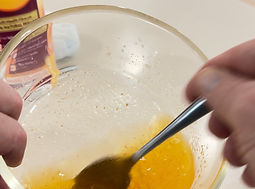
Before you touch anything, look at your list of food suspects.
Write them in your science journal and sort them into two columns: 'I think this has starch' and 'I think this is innocent.
PREDICT
OBSERVE
EVIDENCE
ASK
SAFETY
TIP
PREDICT
Gather your materials and get
ready for an amazing mission!
2
Make the detective liquid
Mix 1 teaspoon of Betadine with 3 teaspoons of water in a small cup.
Stir gently. It should look light brown — like weak tea. This is your indicator solution.
The lighter colour makes the reaction easier to spot when it happens.
PREDICT
OBSERVE
EVIDENCE
ASK
SAFETY
TIP
PREDICT
Gather your materials and get
ready for an amazing mission!
3
Positive & Negative tests
Before you test any food, you need to know exactly what you are looking for.
Positive
- Mix a pinch of cornflour into some water (cornflour is pure starch).
- Add one drop of your detective liquid.
- This is a POSITIVE result
Negative
Mix the detective liquid in water
This is a NEGATIVE result
PREDICT
OBSERVE
EVIDENCE
ASK
SAFETY
TIP
PREDICT
Gather your materials and get
ready for an amazing mission!
4
Set the crime scene
Place each food sample on a separate square of white paper towel or a section of white plate.
Label each one clearly
PREDICT
OBSERVE
EVIDENCE
ASK
SAFETY
TIP
PREDICT
Gather your materials and get
ready for an amazing mission!
5
Test each suspect
Place one drop of your detective liquid onto each food sample. Wait 30 seconds.
Watch carefully. You are looking for one specific thing: does the colour change to dark blue-black
PREDICT
OBSERVE
EVIDENCE
ASK
SAFETY
TIP
PREDICT
Gather your materials and get
ready for an amazing mission!
6
Find the pattern
Look at all the foods that tested positive — the ones that turned dark blue-black.
What do they have in common? Where do those foods come from — animal or plant?
PREDICT
OBSERVE
EVIDENCE
ASK
SAFETY
TIP
PREDICT
Gather your materials and get
ready for an amazing mission!
1
Big Title
Gather your materials and get
ready for an amazing mission!
PREDICT
OBSERVE
EVIDENCE
ASK
SAFETY
TIP
PREDICT
Gather your materials and get
ready for an amazing mission!
1
Big Title
Gather your materials and get
ready for an amazing mission!
PREDICT
OBSERVE
EVIDENCE
ASK
SAFETY
TIP
PREDICT
Gather your materials and get
ready for an amazing mission!
1
Big Title
Gather your materials and get
ready for an amazing mission!
PREDICT
OBSERVE
EVIDENCE
ASK
SAFETY
TIP
PREDICT
1
Brief your suspects
Gather your materials and get
ready for an amazing mission!
PREDICT
OBSERVE
EVIDENCE
ASK
SAFETY
TIP
PREDICT
1
Brief your suspects
Gather your materials and get
ready for an amazing mission!
PREDICT
OBSERVE
EVIDENCE
ASK
SAFETY
TIP
PREDICT
1
Big Title
Gather your materials and get
ready for an amazing mission!
PREDICT
OBSERVE
EVIDENCE
ASK
SAFETY
TIP
PREDICT
The Crazy Scientist LAB Learning System™
Every experiment follows The Crazy Scientist Lab Learning System™ — a simple way to help kids think like real scientists.
We
-
LINK to what they already know,
-
ACTIVATE curiosity through hands-on discovery
-
BUILD understanding that actually sticks.

• You have ten food suspects in front of you. Some of them are hiding something. Some are completely innocent. Your indicator will expose them — but only if you know how to read the result.
• Before you pick up the dropper: look at your suspects and make your predictions. Which ones do you think are hiding something — and why? Write it down. Then test it. Let's see if your detective instincts are right.

Which foods tested positive? Which ones surprised you the most — and why did you predict them wrong?
The foods that tested positive all have something in common. Look carefully at the list. Where do those foods come from? What kind of plant? What part of the plant?
The indicator stayed brown on some foods and turned dark on others. What does that tell you about what the indicator is actually doing — is it reacting with the food itself, or with one specific thing inside it?

• Starch is how plants store energy — like a battery packed into the food. When you eat bread, rice, or potato, your body breaks that starch back down into sugar to use as fuel. Why do you think plants store their energy as starch instead of just leaving it as sugar?
Hospitals use indicator chemicals to test blood and urine for substances that shouldn't be there. Pool owners use indicators to test if the water is safe. Pregnancy tests use indicators. What do all of these have in common with what you just did — and why are indicators so useful?
"Want the full teacher guide? The Crazy Scientist Lab includes classroom delivery tips, how to manage the WOW moment, differentiation for Stage 2 & 3, — ready to teach tomorrow."
Think Like a Scientist
Scientists don't stop after their first discovery.
They ask new questions, collect more evidence and test their ideas in different ways.
Where could you take this investigation next?
Does cooking change whether starch is detected?
Does the concentration of the indicator change how easy it is to read the result?

Dr Puddledrip’s Science Tip
Read the Science
What's the iodine actually doing?
Betadine contains iodine — and iodine is one of nature's best detectives. When iodine meets starch, something dramatic happens: the two lock together and the colour instantly changes from brown to dark blue-black.
When there is no starch, iodine stays brown and moves on. It's not reacting with the sugar, the water, the colour, or the flavour of the food — only the starch.
That makes it what scientists call an indicator: a substance that changes colour only when it finds one specific thing. The dark blue-black is your evidence. Brown means innocent.
Why do plants make starch?
Starch is how plants store energy. Plants make a simple sugar called glucose during photosynthesis — but storing lots of sugar would make them sticky and draw insects and bacteria.
Instead, plants join thousands of glucose molecules together in a long chain that coils up tightly, like a spring. That coiled-up chain is starch.
It has no taste, no colour, and no smell — completely invisible to every one of your senses. It's the plant's way of packing a huge amount of energy into a small, stable, hidden package.
The foods in your experiment that test positive are the ones where the plant stored a lot of starch — usually in seeds, roots, and underground parts where the plant keeps its energy reserves.
Why does iodine change colour inside starch?
When iodine meets a starch coil, it doesn't sit on the surface — it slips inside the spiral, like threading a string through a hollow tube. Once iodine is trapped inside that coil, it absorbs light differently.
Instead of looking brown, it looks dark blue-black. The colour change is instant, reliable, and dramatic. When there's no starch coil to slip into — like in apple flesh, butter, or cheese — the iodine has nowhere to go. It stays brown and nothing changes. This test is so reliable that scientists still use it in food labs, hospitals, and agricultural testing around the world.
Real-world connection
Indicators like iodine are used everywhere. Hospital tests use indicator chemicals to check blood and urine for substances that shouldn't be there. Swimming pool owners use them to check if the water is safe.
Food manufacturers use them to check starch levels in crops before harvest. What they all have in common is the same idea you used today: a chemical that changes colour to reveal something invisible — giving you a clear answer without any guessing.
Try next
• See another chemical test used to reveal something hidden inside a living thing → [The Escape Artist]
• Find out where the glucose that makes starch originally comes from → [A Plant's Hidden Pipes]
Teachers & Homeschoolers: Print-ready HD versions of this Science Behind It poster and companion G&T Challenge Card are available inside The Crazy Scientist LAB.
Scientist's Challenge
Designed for HPGE, gifted learners and children who enjoy an extra challenge.
Teachers & Homeschoolers: Print-ready HD versions of this Science Behind It poster and companion G&T Challenge Card are available inside The Crazy Scientist LAB.
The Next Question...
You've solved today's mystery. Now discover where curiosity can take you next.
What is a carbohydrate?
Starch belongs to a group of molecules called carbohydrates.
The word literally means carbon + water (carbo + hydrate) — carbohydrates are made of carbon, hydrogen, and oxygen atoms.
The simplest carbohydrates are sugars like glucose (a single ring of 6 carbons). Starch is a polysaccharide — a very long chain of glucose rings linked together, sometimes thousands of units long, coiled into a helix. The helix shape is critical: it's the tunnel that iodine slips into, and it's what makes the colour change happen. A straight-chain glucose molecule would not produce the colour change — only the helical coil does.
What does 'like dissolves like' tell us about iodine?
Iodine molecules are non-polar — they don't have positive or negative ends. The inside of a starch helix is also relatively non-polar — it's lined with carbon and hydrogen atoms.
Teachers & Homeschoolers: Print-ready HD versions of this Science Behind It poster and companion G&T Challenge Card are available inside The Crazy Scientist LAB.
Vocabulary
Indicator
A substance that changes colour when it detects a specific chemical. Iodine is an indicator for starch — it turns dark blue-black only when starch is present.
Starch
A substance made by plants to store energy. It is built from thousands of glucose units joined in a long, coiled chain. It has no colour, smell, or taste.
Glucose
A simple sugar that plants make during photosynthesis. Plants join glucose molecules together to make starch for storage.
Iodine
A chemical found in Betadine solution. It slips inside the coiled starch molecule and changes colour from brown to dark blue-black.
Polysaccharide
A very long molecule made by joining many sugar units in a chain. Starch and cellulose are both polysaccharides made from glucose.
Photosynthesis
The process plants use to make glucose from sunlight, water, and carbon dioxide. The glucose is then stored as starch.
Know a parent or teacher who'd love this? Send it on! 👇
Keep Exploring This Mystery
One experiment leads to even more amazing discoveries inside the Learning Universe.
Curiosity Files
BIG Questions & Discovery
Illustrated Facts
Explore • Discover
Road Trip Science
Discover science everywhere
The Teacher's Cauldron
Think. Experiment. Inspire
Books
Read • Explore
Videos
Watch & Learn
LAB Resources
Premium learning resources


- Coming Late 2027
Could You Unmix Chocolate Milk?
- Coming Mid 2027
Could You Really Run Across This Weird Liquid?
Ready for Your Next Discovery?


READY TO TEACH THIS
TOMORROW?

Running the experiment is easy; however, teaching it well is another challenge.
Teachers often ask:
How do I adapt this for Stages 1,2 or 3?
What misconceptions will they have?
What syllabus outcomes does it cover?
What do I do with fast finishers?
How do I structure this for a full class?
What do I say when they ask WHY?
BUILD AROUND THE LAB LEARNING SYSTEM™
Every resource is designed using our teaching framework.

Inside The Crazy Scientist LAB
Everything you need to confidently teach science tomorrow.


Opening early 2027. Join the Founding Member Waitlist
More Ways to Explore The Crazy Scientist World
Discover more hands-on science fun, programs and resources for every curious mind.


