


Professor Picklebottom
Crack the Mystery Goo
Dr Puddledrip was trying to invent the world's stretchiest slime...
Instead, she created something that behaves like two different materials at once.
Sometimes it pours like a liquid.
Sometimes it feels as hard as a rock.
Professor Picklebottom needs your help to discover why.
Can you solve the mystery?

Ages
5-12 yrs
Duration
min
20
Difficulty
Easy
Stage
Stage 1-3
Cite this resource
Created by Darin Carr (BSc, DipEd)
NESA Accredited Teacher · Chemistry & Physics Specialist · 30+ years in-class teaching
Resource Version: 1.0
First Published:
Last Updated:
29 June 2026
10 Aug 2026

MISSION VERIFIED
Classroom tested. Teacher designed. Safe at home.

Designed by Darin Carr (BScDip Ed)
Practising NESA accredited
Australian Science Teacher
★ 30+ years of classroom experience
MISSION PROGRESS
1
young scientists have completed this mission.
I'VE COMPLETED THIS MISSION
Click to let us know you have completed this mission
LATEST TEACHER FEEDBACK
No feedback yet for this experiment. Use it with your class and let us know how it went!

Before you investigate... watch the mystery
MISSION HOOK
Professor Picklebottom and the team are travelling and collecting amazing science mysteries.
✔ Coming in Term 1 2027

KEEP EXPLORING
Curiosity Files
BIG Questions & Discovery
Illustrated Facts
Explore • Discover
Road Trip Science
Discover science everywhere
The Teacher's Cauldron
Think. Experiment. Inspire
Books
Read • Explore
Videos
Watch & Learn
LAB Resources
Premium learning resources

Mission Equipment
Gather your materials and get
ready for an amazing mission!
2 cups cornflour (cornstarch)
About 1 cup water
Large mixing bowl
Spoon
Measuring cups
Small marble
Large marble
Steel ball bearing
2–3 coins
Tray (optional)
Paper towel for clean-up


Let’s Investigate
Follow the missions steps below to solve the mystery.
1
Think Like a Scientist

Before you mix anything, make your predictions.
Read the questions below before you start mixing anything.
PREDICT
OBSERVE
EVIDENCE
ASK
SAFETY
TIP
PREDICT
Gather your materials and get
ready for an amazing mission!
2
Add the Cornflour

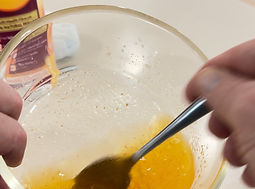
Pour 2 cups of cornflour into a large bowl.
PREDICT
OBSERVE
EVIDENCE
ASK
SAFETY
TIP
PREDICT
Gather your materials and get
ready for an amazing mission!
3
Add Water Slowly

Add a little water at a time while stirring.
Don't pour all the water in at once.
PREDICT
OBSERVE
EVIDENCE
ASK
SAFETY
TIP
PREDICT
Gather your materials and get
ready for an amazing mission!
4
Mix and Adjust

Keep stirring until your Mystery Goo:
• Slowly flows when you tilt the bowl
• Feels firm when you tap it quickly
If it's too runny, add a little more cornflour.
If it's too dry, add a little more water.
PREDICT
OBSERVE
EVIDENCE
ASK
SAFETY
TIP
PREDICT
Gather your materials and get
ready for an amazing mission!
5
Investigation 1 – Small or Large?

Drop a small marble into the Mystery Goo.
Now try a larger marble.
PREDICT
OBSERVE
EVIDENCE
ASK
SAFETY
TIP
PREDICT
Gather your materials and get
ready for an amazing mission!
6
Investigation 2 – Same Size, Different Material

Now test a glass marble and a steel ball bearing.
They are almost the same size, but are made from different materials.
PREDICT
OBSERVE
EVIDENCE
ASK
SAFETY
TIP
PREDICT
Gather your materials and get
ready for an amazing mission!
7
Investigation 3 – Does Speed Matter?
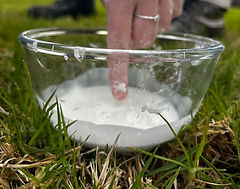
Push one finger slowly into the Mystery Goo.
Now tap or punch the surface quickly.
PREDICT
OBSERVE
EVIDENCE
ASK
SAFETY
TIP
PREDICT
Gather your materials and get
ready for an amazing mission!
8
Investigation 4 – Can You Make a Ball?

Scoop up some Mystery Goo and squeeze it tightly into a ball.
Now stop squeezing.
What happens?
PREDICT
OBSERVE
EVIDENCE
ASK
SAFETY
TIP
PREDICT
Gather your materials and get
ready for an amazing mission!
9
Investigation 5 - Does the Shape Change What Happens?

Drop a coin in different ways. Does its shape (SA) affect how long it takes to sink?
Try the coin facing the goo and then with its edge facing the goo.
Which goes deepest?
PREDICT
OBSERVE
EVIDENCE
ASK
SAFETY
TIP
PREDICT
Look at the cornflour and the water sitting separately.
What do you think will happen when you mix them?
Will it become more like a liquid, more like a solid — or something else entirely?
Record your prediction before you start.
1
Think Like a Scientist
Gather your materials and get
ready for an amazing mission!
PREDICT
OBSERVE
EVIDENCE
ASK
SAFETY
TIP
PREDICT
Look at the cornflour and the water sitting separately.
What do you think will happen when you mix them?
Will it become more like a liquid, more like a solid — or something else entirely?
Record your prediction before you start.
1
Think Like a Scientist
Gather your materials and get
ready for an amazing mission!
PREDICT
OBSERVE
EVIDENCE
ASK
SAFETY
TIP
PREDICT
Look at the cornflour and the water sitting separately.
What do you think will happen when you mix them?
Will it become more like a liquid, more like a solid — or something else entirely?
Record your prediction before you start.
1
Big Title
Gather your materials and get
ready for an amazing mission!
PREDICT
OBSERVE
EVIDENCE
ASK
SAFETY
TIP
PREDICT
Look at the cornflour and the water sitting separately.
What do you think will happen when you mix them?
Will it become more like a liquid, more like a solid — or something else entirely?
Record your prediction before you start.
The Crazy Scientist LAB Learning System™
Every experiment follows The Crazy Scientist Lab Learning System™ — a simple way to help kids think like real scientists.
We
-
LINK to what they already know,
-
ACTIVATE curiosity through hands-on discovery
-
BUILD understanding that actually sticks.

Have you ever…
• squeezed toothpaste out of a tube?
• watched tomato sauce suddenly pour?
• stood on wet sand at the beach?
• stepped in thick mud?
Sometimes materials seem to change how they behave depending on what you do.
Today you’ll investigate one of the strangest materials of all…
Mystery Goo.

Before anyone explained how Mystery Goo worked...
You investigated it yourself.
You made predictions.
You compared different objects.
You tested different speeds.
You looked for patterns and gathered evidence.
With every investigation, you collected another clue about how this strange material behaves.
Now it's time to put those clues together and solve the mystery.

Solving the Mystery
Your investigations revealed something surprising.
When you moved slowly… the Mystery Goo flowed.
When you pushed quickly… it became much firmer.
So why did this happen?
Mystery Goo is made from millions of tiny cornflour particles mixed with water.
When you move slowly, the tiny particles have time to slide past one another.
The mixture flows almost like a liquid.
But when you push, tap or squeeze it quickly… the particles don’t have enough time to move out of the way.
Instead, they become tightly packed together for a very short time.
The mixture suddenly feels much harder.
Scientists call materials that behave like this non-Newtonian fluids.
You don’t need to remember the name.
The important discovery is what you observed:
✔ Slow movement allowed the goo to flow.
✔ Fast movement made it suddenly become firm.
✔ Different investigations helped reveal the pattern.
Just like a scientist, you used evidence to solve the mystery.
"Want the full teacher guide? The Crazy Scientist Lab includes classroom delivery tips, how to manage the WOW moment, differentiation for Stage 2 & 3, — ready to teach tomorrow."
Think Like a Scientist
Scientists don't stop after their first discovery.
They ask new questions, collect more evidence and test their ideas in different ways.
Where could you take this investigation next?
What happens if you use more or less water?
What happens if you leave the goo sitting for 30 minutes before testing it?

Dr Puddledrip’s Science Tip

Read the Science
What is happening inside your Mystery Goo?
Mystery Goo is made from just cornflour and water, but mixing them creates a material with some very unusual properties.
Cornflour contains countless tiny solid particles. When water is added, these particles become suspended throughout the liquid rather than dissolving completely.
Together, the particles and water form a thick mixture called a suspension.
And this suspension doesn't always behave like an ordinary liquid.
Why does Mystery Goo flow when you move it slowly?
Move your fingers slowly through the Mystery Goo and it can ooze, drip and flow.
When the mixture is moved gently, the cornflour particles have enough time to move around one another. Water between the particles helps them slide past each other.
That's why you can slowly pour the goo or let it run between your fingers.
For a moment, it seems just like a very thick liquid.
Why does it suddenly feel solid when you hit it?
Now give the Mystery Goo a quick push, squeeze or tap. Everything changes!
When a sudden force is applied, the cornflour particles are pushed together so quickly that they cannot move out of the way easily. They crowd together and resist movement.
For that brief moment, the mixture becomes much firmer.
Stop applying the force and the particles can begin moving again — so your apparently solid lump turns back into flowing goo.
Is Mystery Goo a solid or a liquid?
This is where things get interesting.
Mystery Goo is known as a non-Newtonian fluid. That means its resistance to flowing — its viscosity — changes depending on the forces acting on it.
Move it slowly and it flows easily.
Apply a sudden force and it becomes much harder to move.
So rather than simply asking, “Is it a solid or a liquid?”, scientists investigate how the material behaves under different conditions.
Where is this strange science used?
Scientists and engineers study materials that can change their behaviour when forces are applied.
Similar ideas can be useful when developing impact-resistant materials, including protective equipment and other technologies designed to be flexible during normal movement but resist sudden impacts.
Studying unusual materials like Mystery Goo helps scientists understand how the microscopic structure of a material can affect the way it behaves on a much larger scale.
Scientists Say…
Mystery Goo is a shear-thickening non-Newtonian fluid.
That sounds complicated, but the big idea is simple:
Slow movement → it flows.
Sudden force → it resists movement.
You haven't changed the ingredients. You've changed how quickly force is applied — and the material responds differently.
Curiosity Spark
You can push your finger slowly into Mystery Goo…
…but what would happen if something moved across it really fast?
Teachers & Homeschoolers: Print-ready HD versions of this Science Behind It poster and companion G&T Challenge Card are available inside The Crazy Scientist LAB.
Scientist's Challenge
Designed for HPGE, gifted learners and children who enjoy an extra challenge.

Teachers & Homeschoolers: Print-ready HD versions of this Science Behind It poster and companion G&T Challenge Card are available inside The Crazy Scientist LAB.
The Next Question...
You've solved today's mystery. Now discover where curiosity can take you next.

Teachers & Homeschoolers: Print-ready HD versions of this Science Behind It poster and companion G&T Challenge Card are available inside The Crazy Scientist LAB.
Vocabulary
Viscosity — How easily a liquid flows. Mystery Goo’s viscosity changes depending on how you move it.
Non-Newtonian fluid — A fluid that can change how easily it flows when force is applied.
Suspension — A mixture where tiny solid particles are spread throughout a liquid without completely dissolving.
Know a parent or teacher who'd love this? Send it on! 👇
Keep Exploring This Mystery
One experiment leads to even more amazing discoveries inside the Learning Universe.
Curiosity Files
BIG Questions & Discovery
Illustrated Facts
Explore • Discover
Road Trip Science
Discover science everywhere
The Teacher's Cauldron
Think. Experiment. Inspire
Books
Read • Explore
Videos
Watch & Learn
LAB Resources
Premium learning resources


- Coming Early 2027
Would Shampoo Still Pour From a Bottle in Space?
- Coming Early 2027
Could You Ever Run Across a Pool of Slime?
- Coming Early 2027
Is Slime a Solid, a Liquid… or Something Weirder?
Ready for Your Next Discovery?


READY TO TEACH THIS
TOMORROW?

Running the experiment is easy; however, teaching it well is another challenge.
Teachers often ask:
How do I adapt this for Stages 1,2 or 3?
What misconceptions will they have?
What syllabus outcomes does it cover?
What do I do with fast finishers?
How do I structure this for a full class?
What do I say when they ask WHY?
BUILD AROUND THE LAB LEARNING SYSTEM™
Every resource is designed using our teaching framework.

Inside The Crazy Scientist LAB
Everything you need to confidently teach science tomorrow.


Opening early 2027. Join the Founding Member Waitlist
More Ways to Explore The Crazy Scientist World
Discover more hands-on science fun, programs and resources for every curious mind.


