


Professor Picklebottom
Exploding Jellyfish
Can trapped gas become powerful enough to burst a plastic bag?
Your mission is to create an exploding jellyfish and investigate what happens as gas builds up inside.
Watch carefully.
Can you spot the clues before the POP?

Ages
5-12 yrs
Duration
min
5
Difficulty
Easy
Stage
Stage 2-3
Cite this resource
Created by Darin Carr (BSc, DipEd)
NESA Accredited Teacher · Chemistry & Physics Specialist · 30+ years in-class teaching
Resource Version: 1.0
First Published:
Last Updated:
10 Mar 2024
4 Aug 2026

MISSION VERIFIED
Classroom tested. Teacher designed. Safe at home.

Designed by Darin Carr (BScDip Ed)
Practising NESA accredited
Australian Science Teacher
★ 30+ years of classroom experience
MISSION PROGRESS
97
young scientists have completed this mission.
I'VE COMPLETED THIS MISSION
Click to let us know you have completed this mission
LATEST TEACHER FEEDBACK
No feedback yet for this experiment. Use it with your class and let us know how it went!

Before you investigate... watch the mystery
MISSION HOOK
Professor Picklebottom and the team are travelling and collecting amazing science mysteries.
✔ Coming in Term 1 2027

KEEP EXPLORING
Curiosity Files
BIG Questions & Discovery
Illustrated Facts
Explore • Discover
Road Trip Science
Discover science everywhere
The Teacher's Cauldron
Think. Experiment. Inspire
Books
Read • Explore
Videos
Watch & Learn
LAB Resources
Premium learning resources

Mission Equipment
Gather your materials and get
ready for an amazing mission!
1 x Snap-lock sandwich bag
Vinegar (1 cup)
2 tablespoon Baking soda
1 x Tissue
Tray (HIGHLY recommended)


Let’s Investigate
Follow the missions steps below to solve the mystery.
1
Big Title
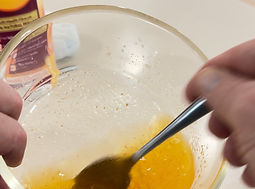
Gather your materials and get
ready for an amazing mission!
PREDICT
OBSERVE
EVIDENCE
ASK
SAFETY
TIP
PREDICT
Gather your materials and get
ready for an amazing mission!
1
Big Title
Gather your materials and get
ready for an amazing mission!
PREDICT
OBSERVE
EVIDENCE
ASK
SAFETY
TIP
PREDICT
Gather your materials and get
ready for an amazing mission!
1
Big Title
Gather your materials and get
ready for an amazing mission!
PREDICT
OBSERVE
EVIDENCE
ASK
SAFETY
TIP
PREDICT
Gather your materials and get
ready for an amazing mission!
1
Big Title
Gather your materials and get
ready for an amazing mission!
PREDICT
OBSERVE
EVIDENCE
ASK
SAFETY
TIP
PREDICT
Gather your materials and get
ready for an amazing mission!
1
Big Title
Gather your materials and get
ready for an amazing mission!
PREDICT
OBSERVE
EVIDENCE
ASK
SAFETY
TIP
PREDICT
Gather your materials and get
ready for an amazing mission!
1
Big Title
Gather your materials and get
ready for an amazing mission!
PREDICT
OBSERVE
EVIDENCE
ASK
SAFETY
TIP
PREDICT
Gather your materials and get
ready for an amazing mission!
1
Big Title
Gather your materials and get
ready for an amazing mission!
PREDICT
OBSERVE
EVIDENCE
ASK
SAFETY
TIP
PREDICT
Gather your materials and get
ready for an amazing mission!
1
Big Title
Gather your materials and get
ready for an amazing mission!
PREDICT
OBSERVE
EVIDENCE
ASK
SAFETY
TIP
PREDICT
Gather your materials and get
ready for an amazing mission!
1
Big Title
Gather your materials and get
ready for an amazing mission!
PREDICT
OBSERVE
EVIDENCE
ASK
SAFETY
TIP
PREDICT
Before you touch anything: what do you think will happen as that gas builds up inside a sealed bag?
Will the bag change shape? Will it feel different?
And what do you think will happen when the bag can no longer stretch any further? Write down your prediction before you start.
1
Think Like a Scientist
Gather your materials and get
ready for an amazing mission!
PREDICT
OBSERVE
EVIDENCE
ASK
SAFETY
TIP
PREDICT
Before you touch anything: what do you think will happen as that gas builds up inside a sealed bag?
Will the bag change shape? Will it feel different?
And what do you think will happen when the bag can no longer stretch any further? Write down your prediction before you start.
1
Think Like a Scientist
Gather your materials and get
ready for an amazing mission!
PREDICT
OBSERVE
EVIDENCE
ASK
SAFETY
TIP
PREDICT
Before you touch anything: what do you think will happen as that gas builds up inside a sealed bag?
Will the bag change shape? Will it feel different?
And what do you think will happen when the bag can no longer stretch any further? Write down your prediction before you start.
1
Big Title
Gather your materials and get
ready for an amazing mission!
PREDICT
OBSERVE
EVIDENCE
ASK
SAFETY
TIP
PREDICT
Before you touch anything: what do you think will happen as that gas builds up inside a sealed bag?
Will the bag change shape? Will it feel different?
And what do you think will happen when the bag can no longer stretch any further? Write down your prediction before you start.
The Crazy Scientist LAB Learning System™
Every experiment follows The Crazy Scientist Lab Learning System™ — a simple way to help kids think like real scientists.
We
-
LINK to what they already know,
-
ACTIVATE curiosity through hands-on discovery
-
BUILD understanding that actually sticks.

Have you ever shaken a fizzy drink and watched it explode
What do you think is building up inside before it pops?

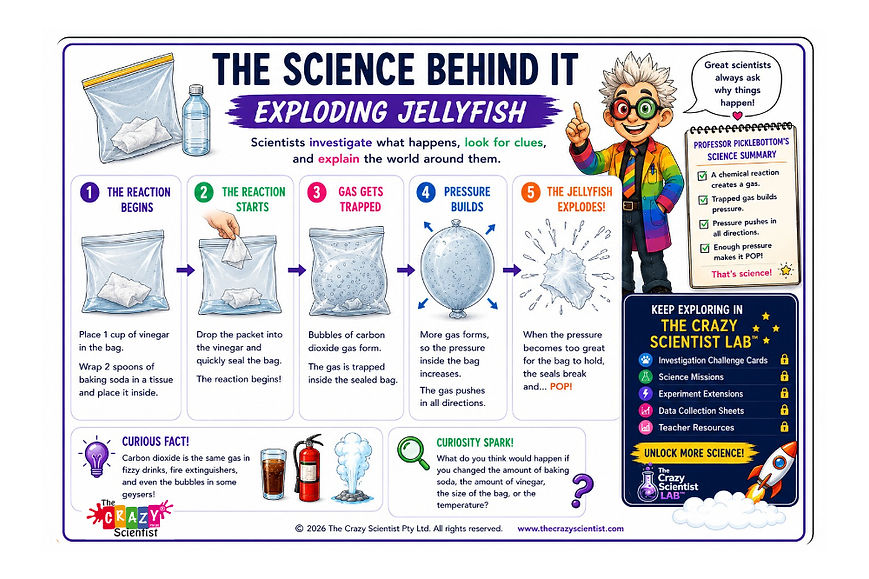
When baking soda reacts with vinegar, it produces a gas called carbon dioxide.
This gas builds up inside the bag, pushing outwards…
until the bag can’t hold it anymore — POP!

The same acid-and-base reaction that inflated your bag is what happens inside baking powder the moment it touches hot cake batter — those tiny CO₂ bubbles are what make a cake rise and go fluffy.
It's also what happens in an antacid tablet fizzing in a glass of water to settle an upset stomach.
Whenever an acid meets a base, gas is the result.
Can you think of other places in everyday life where you might be using an acid-base reaction without realising it?
"Want the full teacher guide? The Crazy Scientist Lab includes classroom delivery tips, how to manage the WOW moment, differentiation for Stage 2 & 3, — ready to teach tomorrow."
Think Like a Scientist
Scientists don't stop after their first discovery.
They ask new questions, collect more evidence and test their ideas in different ways.
Where could you take this investigation next?
What happens if you change how much vinegar you use?
What happens if the temperature changes?

Dr Puddledrip’s Science Tip

Read the Science
Why Did The Jellyfish Explode?
When baking soda and vinegar mix together, they react and create a gas called carbon dioxide.
The gas begins forming almost immediately. Because the bag is sealed, the gas cannot escape and becomes trapped inside.
As more gas is produced, the bag fills up and starts to stretch. The gas particles push against the inside of the bag, creating pressure.
Eventually, the pressure becomes greater than the bag can hold and…
POP!
The jellyfish bursts open!
Scientists Say…
Gas takes up space and pushes in all directions.
When gas is trapped inside a container, pressure can build up.
The more gas that forms, the greater the pressure becomes.
In this investigation, the pressure inside the bag became so great that the bag burst.
Curiosity Spark
Scientists often investigate questions such as:
Does more baking soda create more gas?
Does temperature affect the reaction?
Can a bigger bag hold more pressure?
What would you investigate next?
Teachers & Homeschoolers: Print-ready HD versions of this Science Behind It poster and companion G&T Challenge Card are available inside The Crazy Scientist LAB.
Scientist's Challenge
Designed for HPGE, gifted learners and children who enjoy an extra challenge.
Teachers & Homeschoolers: Print-ready HD versions of this Science Behind It poster and companion G&T Challenge Card are available inside The Crazy Scientist LAB.
The Next Question...
You've solved today's mystery. Now discover where curiosity can take you next.
Can You Build A Bigger Jellyfish?
Your jellyfish exploded.
But can you make one that grows even larger before it pops?
Scientists investigate by changing ONE thing at a time.
Choose ONE variable to test:
☐ Amount of baking soda
☐ Amount of vinegar
☐ Size of the bag

Teachers & Homeschoolers: Print-ready HD versions of this Science Behind It poster and companion G&T Challenge Card are available inside The Crazy Scientist LAB.
Vocabulary
Carbon Dioxide
A gas produced when baking soda and vinegar react together.
Pressure
A pushing force created when gas presses against the inside of a container.
Chemical Reaction — a change that makes a new substance
Gas — a substance that spreads out and fills any space it's in
Know a parent or teacher who'd love this? Send it on! 👇
Keep Exploring This Mystery
One experiment leads to even more amazing discoveries inside the Learning Universe.
Curiosity Files
BIG Questions & Discovery
Illustrated Facts
Explore • Discover
Road Trip Science
Discover science everywhere
The Teacher's Cauldron
Think. Experiment. Inspire
Books
Read • Explore
Videos
Watch & Learn
LAB Resources
Premium learning resources


- Coming Early 2027
Why Doesn't a Volcano Need Fire to Erupt?
- Coming Late 2027
Could You Make a Jellyfish Explode Without Hurting It?
Ready for Your Next Discovery?


READY TO TEACH THIS
TOMORROW?

Running the experiment is easy; however, teaching it well is another challenge.
Teachers often ask:
How do I adapt this for Stages 1,2 or 3?
What misconceptions will they have?
What syllabus outcomes does it cover?
What do I do with fast finishers?
How do I structure this for a full class?
What do I say when they ask WHY?
BUILD AROUND THE LAB LEARNING SYSTEM™
Every resource is designed using our teaching framework.

Inside The Crazy Scientist LAB
Everything you need to confidently teach science tomorrow.


Opening early 2027. Join the Founding Member Waitlist
More Ways to Explore The Crazy Scientist World
Discover more hands-on science fun, programs and resources for every curious mind.


