


Dr Puddledrip
The Mummy Maker
Dr Puddledrip has uncovered a 3,000-year-old mystery…
Ancient Egyptian embalmers could stop a body from decaying long enough for it to survive for thousands of years.
But how did they do it?
Dr Puddledrip thinks the secret was hidden in a strange substance packed around the body — and she wants you to test what it actually did.
Will your “mummy” stay the same?
Will it dry out?
Will it decay more slowly than one left in the open air?
Your mission: investigate the chemistry that helped make a mummy.
Ages
9-12 yrs
Duration
min
15
Difficulty
Easy
Stage
Stage 2-3
Cite this resource
Created by Darin Carr (BSc, DipEd)
NESA Accredited Teacher · Chemistry & Physics Specialist · 30+ years in-class teaching
Resource Version: 1.0
First Published:
Last Updated:
23 Apr 2026
27 Aug 2026

MISSION VERIFIED
Classroom tested. Teacher designed. Safe at home.

Designed by Darin Carr (BScDip Ed)
Practising NESA accredited
Australian Science Teacher
★ 30+ years of classroom experience
MISSION PROGRESS
9
young scientists have completed this mission.
I'VE COMPLETED THIS MISSION
Click to let us know you have completed this mission
LATEST TEACHER FEEDBACK
No feedback yet for this experiment. Use it with your class and let us know how it went!

Before you investigate... watch the mystery
MISSION HOOK
Professor Picklebottom and the team are travelling and collecting amazing science mysteries.
✔ Coming in Term 1 2027

KEEP EXPLORING
Curiosity Files
BIG Questions & Discovery
Illustrated Facts
Explore • Discover
Road Trip Science
Discover science everywhere
The Teacher's Cauldron
Think. Experiment. Inspire
Books
Read • Explore
Videos
Watch & Learn
LAB Resources
Premium learning resources

Mission Equipment
Gather your materials and get
ready for an amazing mission!
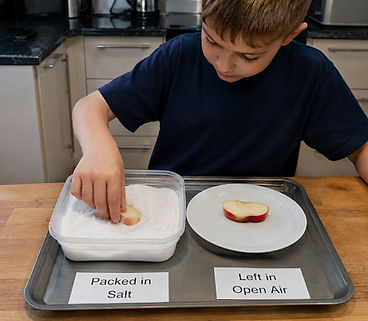
• Table salt (or equal mix of baking soda and salt to simulate natron)
• Two identical apple slices or small pieces of raw chicken
• Two small containers or ziplock bags
• Paper towels
• Labels
• Camera or phone for daily photo documentation


Let’s Investigate
Follow the missions steps below to solve the mystery.
1
Set Up the Control
Place one apple slice in an open container labelled CONTROL.
Leave it exposed to air at room temperature.
This sample will show what happens without the natron mixture.
PREDICT
OBSERVE
EVIDENCE
ASK
SAFETY
TIP
PREDICT
Gather your materials and get
ready for an amazing mission!
2
Make the Natron Mix
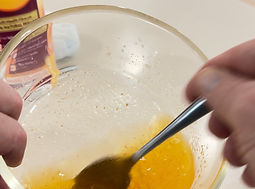
Mix equal parts table salt and baking soda to make your natron model.
Make enough to completely surround your second sample.
PREDICT
OBSERVE
EVIDENCE
ASK
SAFETY
TIP
PREDICT
Gather your materials and get
ready for an amazing mission!
3
Bury the “Mummy”
Place the second apple slice in a separate container.
Cover it completely with the natron mixture.
Label this container NATRON and seal it.
PREDICT
OBSERVE
EVIDENCE
ASK
SAFETY
TIP
PREDICT
Gather your materials and get
ready for an amazing mission!
4
Record Your Starting Evidence.
TPhotograph both samples before the experiment really gets underway.
Record their starting:colour
texture
size
firmness
PREDICT
OBSERVE
EVIDENCE
ASK
SAFETY
TIP
PREDICT
Gather your materials and get
ready for an amazing mission!
5
Daily Records
Check both samples once each day.
Photograph them and record what you notice.
Look for changes in:colour
texture
size
firmness
visible mould
PREDICT
OBSERVE
EVIDENCE
ASK
SAFETY
TIP
PREDICT
Gather your materials and get
ready for an amazing mission!
6
Day 7 Reveal
After 7 days, compare the two samples.
Carefully remove the natron sample and brush away the mixture.
Compare its colour, texture, size and firmness with the control.
PREDICT
OBSERVE
EVIDENCE
ASK
SAFETY
TIP
PREDICT
Gather your materials and get
ready for an amazing mission!
1
Big Title
Gather your materials and get
ready for an amazing mission!
PREDICT
OBSERVE
EVIDENCE
ASK
SAFETY
TIP
PREDICT
Gather your materials and get
ready for an amazing mission!
1
Big Title
Gather your materials and get
ready for an amazing mission!
PREDICT
OBSERVE
EVIDENCE
ASK
SAFETY
TIP
PREDICT
Gather your materials and get
ready for an amazing mission!
1
Big Title
Gather your materials and get
ready for an amazing mission!
PREDICT
OBSERVE
EVIDENCE
ASK
SAFETY
TIP
PREDICT
1
Set Up the Control
Gather your materials and get
ready for an amazing mission!
PREDICT
OBSERVE
EVIDENCE
ASK
SAFETY
TIP
PREDICT
1
Set Up the Control
Gather your materials and get
ready for an amazing mission!
PREDICT
OBSERVE
EVIDENCE
ASK
SAFETY
TIP
PREDICT
1
Big Title
Gather your materials and get
ready for an amazing mission!
PREDICT
OBSERVE
EVIDENCE
ASK
SAFETY
TIP
PREDICT
The Crazy Scientist LAB Learning System™
Every experiment follows The Crazy Scientist Lab Learning System™ — a simple way to help kids think like real scientists.
We
-
LINK to what they already know,
-
ACTIVATE curiosity through hands-on discovery
-
BUILD understanding that actually sticks.

Have you ever wondered how ancient Egyptian mummies have survived for thousands of years?
Why didn't they simply rot away?
Something removed the water that bacteria needed to survive.
Today, you'll investigate how drying can preserve living things.

Open both containers on Day 5 and compare.
Describe every difference you can see — colour, texture, moisture, smell. What surprises you most?
Look carefully at the control sample. What can you see growing or changing on the surface? What do you think is causing it?
The salt-buried sample looks very different. What do you think the salt actually did to it? Make your best prediction before you read the science.

Your control sample is rotting. The salt-buried one is not. What did the salt change about the conditions that tiny living things need to survive?
Did the salt kill the tiny organisms causing decay — or did it just take away something they need? What’s the difference between killing and preventing?
Egyptian mummies were buried in dry desert tombs after the natron process. How did the hot, dry environment help the preservation last thousands of years?
"Want the full teacher guide? The Crazy Scientist Lab includes classroom delivery tips, how to manage the WOW moment, differentiation for Stage 2 & 3, — ready to teach tomorrow."
Think Like a Scientist
Scientists don't stop after their first discovery.
They ask new questions, collect more evidence and test their ideas in different ways.
Where could you take this investigation next?
Salt concentration — light sprinkle vs half-buried vs completely buried. Does completeness of coverage matter?
Food type — apple vs banana vs raw chicken. Which preserves most effectively in salt?
Dr Puddledrip’s Science Tip

Read the Science
What’s really happening?
When food is left in the open, microorganisms such as bacteria and fungi can begin breaking it down.
These microorganisms grow best when they have enough water, nutrients and suitable conditions.
Salt helps preserve food because it draws water out of the food and makes less water available for microorganisms to use.
With less available water, bacteria and fungi struggle to grow and reproduce, so decay slows down.
That’s why your natron-treated sample may have become drier and changed more slowly than the control.
Ancient Egyptian connection
More than 3,000 years ago, ancient Egyptian embalmers used a naturally occurring mineral mixture called natron.
They packed bodies in natron for many days to draw out moisture and dry the tissues.
Once dried, the body could be wrapped and prepared for burial.
Removing water was one of the key reasons mummified bodies could resist decay for such extraordinary lengths of time.
Where do we still use this today?
Humans still preserve foods by reducing the amount of water available to microorganisms.
You can see the same idea in:
beef jerky
dried fruit
salt-cured fish
dried herbs
Different materials — same preservation principle.
Big question
If removing water slows down decay…
why don’t dried foods last forever?
Try next
Find out what happens when microorganisms have plenty of moisture and food → The Invisible Colony
Explore another chemical change that permanently alters a material → [Hidden Messages]
Teachers & Homeschoolers: Print-ready HD versions of this Science Behind It poster and companion G&T Challenge Card are available inside The Crazy Scientist LAB.
Scientist's Challenge
Designed for HPGE, gifted learners and children who enjoy an extra challenge.

Teachers & Homeschoolers: Print-ready HD versions of this Science Behind It poster and companion G&T Challenge Card are available inside The Crazy Scientist LAB.
The Next Question...
You've solved today's mystery. Now discover where curiosity can take you next.
What is osmosis?
Osmosis is the movement of water through a thin barrier from an area of low dissolved substances to an area of high dissolved substances.
The cell walls of food act like thin membranes — they let water pass through but not large dissolved particles like salt. When you surround food with salt, the high concentration of salt outside draws water through those cell walls and out of the food.

Teachers & Homeschoolers: Print-ready HD versions of this Science Behind It poster and companion G&T Challenge Card are available inside The Crazy Scientist LAB.
Vocabulary
Osmosis
The movement of water through a thin barrier from an area with less dissolved substance to an area with more, trying to balance the two sides out.
Natron
A naturally occurring salt found near dried lake beds in ancient Egypt. Embalmers used it to draw moisture out of bodies during the mummification process.
Know a parent or teacher who'd love this? Send it on! 👇
Keep Exploring This Mystery
One experiment leads to even more amazing discoveries inside the Learning Universe.
Curiosity Files
BIG Questions & Discovery
Illustrated Facts
Explore • Discover
Road Trip Science
Discover science everywhere
The Teacher's Cauldron
Think. Experiment. Inspire
Books
Read • Explore
Videos
Watch & Learn
LAB Resources
Premium learning resources


- Coming Early 2027
Why Haven't Egyptian Mummies Turned to Dust?
- Coming Mid 2027
How Can Scientists Tell if Something Is Older Than Grandma?
Ready for Your Next Discovery?


READY TO TEACH THIS
TOMORROW?

Running the experiment is easy; however, teaching it well is another challenge.
Teachers often ask:
How do I adapt this for Stages 1,2 or 3?
What misconceptions will they have?
What syllabus outcomes does it cover?
What do I do with fast finishers?
How do I structure this for a full class?
What do I say when they ask WHY?
BUILD AROUND THE LAB LEARNING SYSTEM™
Every resource is designed using our teaching framework.

Inside The Crazy Scientist LAB
Everything you need to confidently teach science tomorrow.


Opening early 2027. Join the Founding Member Waitlist
More Ways to Explore The Crazy Scientist World
Discover more hands-on science fun, programs and resources for every curious mind.


