


Professor Picklebottom
Mentos and Coke
Professor Picklebottom has prepared three identical Mentos volcanoes.
One is ice-cold.
One is at room temperature.
One has been warmed in the sun (or warm water).
They all contain the same soft drink.
They all use the same number of Mentos.
But one volcano will create the biggest Soda Supernova!
Can you predict the champion before launch?

Ages
7-12 yrs
Duration
min
5
Difficulty
Easy
Stage
Stage 2
Cite this resource
Created by Darin Carr (BSc, DipEd)
NESA Accredited Teacher · Chemistry & Physics Specialist · 30+ years in-class teaching
Resource Version: 1.0
First Published:
Last Updated:
4 Jan 2024
31 July 2026

MISSION VERIFIED
Classroom tested. Teacher designed. Safe at home.

Designed by Darin Carr (BScDip Ed)
Practising NESA accredited
Australian Science Teacher
★ 30+ years of classroom experience
MISSION PROGRESS
39
young scientists have completed this mission.
I'VE COMPLETED THIS MISSION
Click to let us know you have completed this mission
LATEST TEACHER FEEDBACK
No feedback yet for this experiment. Use it with your class and let us know how it went!

Before you investigate... watch the mystery
MISSION HOOK
Professor Picklebottom and the team are travelling and collecting amazing science mysteries.
✔ Coming in Term 1 2027

KEEP EXPLORING
Curiosity Files
BIG Questions & Discovery
Illustrated Facts
Explore • Discover
Road Trip Science
Discover science everywhere
The Teacher's Cauldron
Think. Experiment. Inspire
Books
Read • Explore
Videos
Watch & Learn
LAB Resources
Premium learning resources

Mission Equipment
Gather your materials and get
ready for an amazing mission!
1 bottle Diet Coke
1 pack Mint Mentos
Hot glue gun (adult help)
Safety glasses


Let’s Investigate
Follow the missions steps below to solve the mystery.
1
Label Your Volcanoes

Label three bottles:
Cold
Room Temp
Warm
PREDICT
OBSERVE
EVIDENCE
ASK
SAFETY
TIP
PREDICT
Gather your materials and get
ready for an amazing mission!
2
Make the Launcher

With adult help, use a hot glue gun to glue 10 Mentos together in a straight stack.
Adult help required.
PREDICT
OBSERVE
EVIDENCE
ASK
SAFETY
TIP
PREDICT
Gather your materials and get
ready for an amazing mission!
3
Prepare The Launch Zone
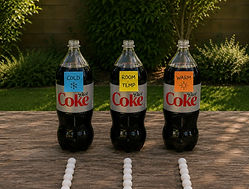
Place all bottles outside.
Put on safety glasses.
Stand well back.
PREDICT
OBSERVE
EVIDENCE
ASK
SAFETY
TIP
PREDICT
Gather your materials and get
ready for an amazing mission!
4
Prediction Time

Which volcano will erupt the highest?
□ Cold
□ Room Temp
□ Warm
PREDICT
OBSERVE
EVIDENCE
ASK
SAFETY
TIP
PREDICT
Gather your materials and get
ready for an amazing mission!
5
Launch

Drop the Mentos stack into the first bottle.
Watch carefully.
Repeat for the other volcanoes.
PREDICT
OBSERVE
EVIDENCE
ASK
SAFETY
TIP
PREDICT
Gather your materials and get
ready for an amazing mission!
1
Big Title
Gather your materials and get
ready for an amazing mission!
PREDICT
OBSERVE
EVIDENCE
ASK
SAFETY
TIP
PREDICT
Gather your materials and get
ready for an amazing mission!
1
Big Title
Gather your materials and get
ready for an amazing mission!
PREDICT
OBSERVE
EVIDENCE
ASK
SAFETY
TIP
PREDICT
Gather your materials and get
ready for an amazing mission!
1
Big Title
Gather your materials and get
ready for an amazing mission!
PREDICT
OBSERVE
EVIDENCE
ASK
SAFETY
TIP
PREDICT
Gather your materials and get
ready for an amazing mission!
1
Big Title
Gather your materials and get
ready for an amazing mission!
PREDICT
OBSERVE
EVIDENCE
ASK
SAFETY
TIP
PREDICT
1
Label Your Volcanoes
Gather your materials and get
ready for an amazing mission!
PREDICT
OBSERVE
EVIDENCE
ASK
SAFETY
TIP
PREDICT
1
Label Your Volcanoes
Gather your materials and get
ready for an amazing mission!
PREDICT
OBSERVE
EVIDENCE
ASK
SAFETY
TIP
PREDICT
1
Big Title
Gather your materials and get
ready for an amazing mission!
PREDICT
OBSERVE
EVIDENCE
ASK
SAFETY
TIP
PREDICT
The Crazy Scientist LAB Learning System™
Every experiment follows The Crazy Scientist Lab Learning System™ — a simple way to help kids think like real scientists.
We
-
LINK to what they already know,
-
ACTIVATE curiosity through hands-on discovery
-
BUILD understanding that actually sticks.

Have you ever shaken a bottle of soft drink and watched it explode everywhere?
What do you think is hiding inside that causes all that fizz?

Watch what happens the moment the Mentos hit the liquid.
Where are the bubbles forming — on the Mentos themselves, or in the liquid?
Why does it happen so explosively fast?
What do you think would happen if you used a different drink?

Rapid gas release forcing liquid out is the same principle behind a fire extinguisher canister and the pop when you open a bottle of sparkling water.
Even natural geysers like Yellowstone work this way — pressure builds underground until water and steam burst upward.
The faster the gas forms, the bigger the eruption.
Can you think of a situation where you'd actually want that gas to build slowly and release in a controlled way instead?
"Want the full teacher guide? The Crazy Scientist Lab includes classroom delivery tips, how to manage the WOW moment, differentiation for Stage 2 & 3, — ready to teach tomorrow."
Think Like a Scientist
Scientists don't stop after their first discovery.
They ask new questions, collect more evidence and test their ideas in different ways.
Where could you take this investigation next?
What happens if you change how many Mentos you use?
What happens if you try a different drink?

Dr Puddledrip’s Science Tip

Read the Science
You can feel the fizz the moment you open a can of Coke. That fizziness is carbon dioxide gas — CO₂ — dissolved into the liquid under pressure. The can is like a coiled spring: there's a huge amount of CO₂ in there, just waiting for a chance to escape.
The escape needs a starting point. A bubble can't simply appear in the middle of a liquid — it needs something tiny to grip onto. Scientists call these nucleation sites — microscopic rough spots where dissolved gas can break free and form a bubble.
Here's the Mentos secret. Each sweet looks smooth, but zoom in and the surface is covered in thousands of tiny pits — more like a golf ball than a marble. Every one of those pits is a nucleation site: a launching pad for a bubble. The moment a Mentos drops into the Coke, all those launching pads fire at once. Thousands of bubbles form simultaneously, race upward, and carry a column of liquid with them. That's the geyser.
Here's the important part: this is not a chemical reaction. Nothing new is being created. The Mentos is simply unlocking the CO₂ that was already in the drink — all at once — by giving it thousands of places to start. You can see the same CO₂ gas doing very different work in [Lava Lubes], where bubbles lift oil droplets to the surface, and in [The Invisible Fire Extinguisher], where CO₂ is used to smother a flame. Same gas — completely different science.
Teachers & Homeschoolers: Print-ready HD versions of this Science Behind It poster and companion G&T Challenge Card are available inside The Crazy Scientist LAB.
Scientist's Challenge
Designed for HPGE, gifted learners and children who enjoy an extra challenge.

Teachers & Homeschoolers: Print-ready HD versions of this Science Behind It poster and companion G&T Challenge Card are available inside The Crazy Scientist LAB.
The Next Question...
You've solved today's mystery. Now discover where curiosity can take you next.

Teachers & Homeschoolers: Print-ready HD versions of this Science Behind It poster and companion G&T Challenge Card are available inside The Crazy Scientist LAB.
Vocabulary
Carbon Dioxide (CO₂)
A gas dissolved inside soft drinks under pressure. When the pressure is released, the gas can escape and form bubbles.
Nucleation Site
A tiny rough spot where bubbles can begin to form. Scientists use this word to describe the starting point for a bubble.
Know a parent or teacher who'd love this? Send it on! 👇
Keep Exploring This Mystery
One experiment leads to even more amazing discoveries inside the Learning Universe.
Curiosity Files
BIG Questions & Discovery
Illustrated Facts
Explore • Discover
Road Trip Science
Discover science everywhere
The Teacher's Cauldron
Think. Experiment. Inspire
Books
Read • Explore
Videos
Watch & Learn
LAB Resources
Premium learning resources


- Coming Mid 2027
Could a FART Move You Through Space?!
- Coming Early 2027
Why Do Mentos Make Coke Erupt?
Ready for Your Next Discovery?


READY TO TEACH THIS
TOMORROW?

Running the experiment is easy; however, teaching it well is another challenge.
Teachers often ask:
How do I adapt this for Stages 1,2 or 3?
What misconceptions will they have?
What syllabus outcomes does it cover?
What do I do with fast finishers?
How do I structure this for a full class?
What do I say when they ask WHY?
BUILD AROUND THE LAB LEARNING SYSTEM™
Every resource is designed using our teaching framework.

Inside The Crazy Scientist LAB
Everything you need to confidently teach science tomorrow.


Opening early 2027. Join the Founding Member Waitlist
More Ways to Explore The Crazy Scientist World
Discover more hands-on science fun, programs and resources for every curious mind.


