


Professor Picklebottom
The Skittle Rainbow
Most people think they know how this experiment works.
Colourful sweets. Water. A rainbow.
Simple.
But then something strange happens.
The colours race across the plate… yet when they meet, they refuse to mix.
Even stranger, with one tiny change, you can make the rainbow appear to move backwards.
Can you work out what’s really going on?

Ages
5-12 yrs
Duration
min
25
Difficulty
Easy
Stage
Stage 1-3
Cite this resource
Created by Darin Carr (BSc, DipEd)
NESA Accredited Teacher · Chemistry & Physics Specialist · 30+ years in-class teaching
Resource Version: 1.0
First Published:
Last Updated:
9 Apr 2026
21 Aug 2026

MISSION VERIFIED
Classroom tested. Teacher designed. Safe at home.

Designed by Darin Carr (BScDip Ed)
Practising NESA accredited
Australian Science Teacher
★ 30+ years of classroom experience
MISSION PROGRESS
75
young scientists have completed this mission.
I'VE COMPLETED THIS MISSION
Click to let us know you have completed this mission
LATEST TEACHER FEEDBACK
No feedback yet for this experiment. Use it with your class and let us know how it went!

Before you investigate... watch the mystery
MISSION HOOK
Professor Picklebottom and the team are travelling and collecting amazing science mysteries.
✔ Coming in Term 1 2027

KEEP EXPLORING
Curiosity Files
BIG Questions & Discovery
Illustrated Facts
Explore • Discover
Road Trip Science
Discover science everywhere
The Teacher's Cauldron
Think. Experiment. Inspire
Books
Read • Explore
Videos
Watch & Learn
LAB Resources
Premium learning resources

Mission Equipment
Gather your materials and get
ready for an amazing mission!
One packet of Skittles — you need at least 2 of each colour (red, orange, yellow, green, purple)
A flat white plate with a rim
Room-temperature water
One sugar cube or one teaspoon of loose sugar
Optional: a dropper or spoon for precise water pouring
Optional: M&Ms or Smarties for comparison testing

Let’s Investigate
Follow the missions steps below to solve the mystery.
1
Build the circle
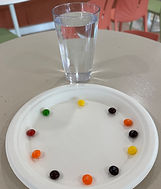
Sort your Skittles by colour. Arrange them in a circle around the rim of the plate — one colour at a time, in rainbow order: red, orange, yellow, green, purple.
Use at least 2 Skittles of each colour
PREDICT
OBSERVE
EVIDENCE
ASK
SAFETY
TIP
PREDICT
Gather your materials and get
ready for an amazing mission!
2
Predictions

Before you add any water — predict. When water touches the Skittles, the colour and sugar coating will dissolve and spread inward across the plate. When the colours from different Skittles reach each other in the middle, what will happen?
PREDICT
OBSERVE
EVIDENCE
ASK
SAFETY
TIP
PREDICT
Gather your materials and get
ready for an amazing mission!
3
Add water

Slowly and carefully pour room-temperature water into the centre of the plate until the base is covered — about 4–5 mm deep.
Try not to disturb the Skittles. Then step back and watch without touching the plate.
PREDICT
OBSERVE
EVIDENCE
ASK
SAFETY
TIP
PREDICT
Gather your materials and get
ready for an amazing mission!
4
Observe the boundary

Watch as the colours flow inward and meet.
Look closely at the point where two different colours reach each other.
Describe exactly what you see — do the colours blend, blur, or hold a line?
PREDICT
OBSERVE
EVIDENCE
ASK
SAFETY
TIP
PREDICT
Gather your materials and get
ready for an amazing mission!
5
Predict again

Now look at the coloured streams meeting in the middle.
You are about to place a sugar cube directly into the centre of the plate — inside all the colour streams.
Predict: what will the sugar cube do to the colours around it? Will it pull the colours toward it, push them away, or have no effect?
PREDICT
OBSERVE
EVIDENCE
ASK
SAFETY
TIP
PREDICT
Gather your materials and get
ready for an amazing mission!
6
Add the sugar cube

Once the colour streams have met and settled into a stable pattern, place a sugar cube (or a small teaspoon of loose sugar) carefully into the exact centre of the plate.
Watch what happens to the boundary lines.
PREDICT
OBSERVE
EVIDENCE
ASK
SAFETY
TIP
PREDICT
Gather your materials and get
ready for an amazing mission!
1
Big Title
Gather your materials and get
ready for an amazing mission!
PREDICT
OBSERVE
EVIDENCE
ASK
SAFETY
TIP
PREDICT
Gather your materials and get
ready for an amazing mission!
1
Big Title
Gather your materials and get
ready for an amazing mission!
PREDICT
OBSERVE
EVIDENCE
ASK
SAFETY
TIP
PREDICT
Gather your materials and get
ready for an amazing mission!
1
Big Title
Gather your materials and get
ready for an amazing mission!
PREDICT
OBSERVE
EVIDENCE
ASK
SAFETY
TIP
PREDICT
1
Build the circle
Gather your materials and get
ready for an amazing mission!
PREDICT
OBSERVE
EVIDENCE
ASK
SAFETY
TIP
PREDICT
1
Build the circle
Gather your materials and get
ready for an amazing mission!
PREDICT
OBSERVE
EVIDENCE
ASK
SAFETY
TIP
PREDICT
1
Big Title
Gather your materials and get
ready for an amazing mission!
PREDICT
OBSERVE
EVIDENCE
ASK
SAFETY
TIP
PREDICT
The Crazy Scientist LAB Learning System™
Every experiment follows The Crazy Scientist Lab Learning System™ — a simple way to help kids think like real scientists.
We
-
LINK to what they already know,
-
ACTIVATE curiosity through hands-on discovery
-
BUILD understanding that actually sticks.

Have you ever dropped a single drop of food colouring into a glass of still water and watched it slowly spread — without stirring, without being pushed — until eventually the whole glass was coloured?
What is carrying the the colour? Something is moving — but nothing is pushing it. What do you think is driving that movement?
Now look at the Skittles arranged on the plate. Each one has a sugar-and-dye coating that is about to dissolve.
Before you pour a drop of water — predict: will the colours flow toward the centre, away from it, or stay close to their Skittle? And when the colours from different Skittles reach each other in the middle — will they mix, or will they stop?

You've watched a rainbow form — and watched it hold its shape at the boundaries.
Think back to the moment the first colours reached each other. Describe what happened at the boundary. Did they blend, blur, or stop? Was the line sharp or fuzzy?
You predicted whether the colours would mix. Were you right? If the colours stopped at the boundary — think about what was the same about each stream arriving there. What was equal about them?
Every Skittle in the circle dissolved the same coating in the same depth of water at the same time. What does that tell you about the sugar concentration of each coloured stream — and why might two streams of equal concentration stop instead of mixing?
The sugar cube produced a very different result from the Skittles. What was different about how much sugar it added to the centre — and why did the colours respond by moving away instead of staying still?

Solutions flow from where they are concentrated to where they are dilute. When two solutions of equal concentration meet, neither has a reason to flow into the other — and a boundary holds.
"Want the full teacher guide? The Crazy Scientist Lab includes classroom delivery tips, how to manage the WOW moment, differentiation for Stage 2 & 3, — ready to teach tomorrow."
Think Like a Scientist
Scientists don't stop after their first discovery.
They ask new questions, collect more evidence and test their ideas in different ways.
Where could you take this investigation next?
Does water temperature change how quickly the rainbow forms?
Does the number of Skittles per colour group change the result? Compare using 1 Skittle per colour (5 total in the circle), 3 per colour (15 total),
Dr Puddledrip’s Science Tip

Read the Science
Why do the colours move?
When water touches the Skittles, something interesting happens.
The colourful coating on the outside begins to dissolve and spread into the water.
Each Skittle releases its own colour, creating the rainbow effect you observed.
But did you notice something strange?
The colours don’t rush across the whole plate. Instead, they seem to travel in organised streams.
Why might that happen?
Why do the colours stop when they meet?
This is the part that surprises most scientists-in-training.
When the coloured streams reach the middle of the plate, they often stop instead of mixing together.
At first glance, that seems impossible.
After all, liquids usually mix when they touch.
So why do these colours sometimes stay separated?
Scientists investigate questions like this by looking closely at what is happening in the water.
Can you think of any ideas that might explain it?
What changed when you added the sugar cube?
The sugar cube created a completely different pattern.
Instead of moving toward the centre, some of the colours appeared to move away from it.
Something in the water changed.
Scientists often discover new ideas when they change just one part of an experiment and carefully observe what happens next.
What do you think the sugar cube changed?
Real-World Connection
Scientists study how substances move and mix in liquids.
These same ideas help scientists investigate:
ocean currents
weather systems
pollution in rivers
how nutrients move through living things
The Skittles rainbow gives us a tiny window into a much bigger scientific world.
Curiosity Spark
The colours seemed to stop when they met.
But what if you used:
hot water?
cold water?
different sweets?
a larger plate?
Would the colours behave the same way?
Or would something completely different happen?
Try next
• See another experiment where the invisible movement of molecules creates a visible effect → [The Pepper Escape]
• Explore how concentration differences drive a completely different kind of colour change → [The Colour Climb]
Teachers & Homeschoolers: Print-ready HD versions of this Science Behind It poster and companion G&T Challenge Card are available inside The Crazy Scientist LAB.
Scientist's Challenge
Designed for HPGE, gifted learners and children who enjoy an extra challenge.

Teachers & Homeschoolers: Print-ready HD versions of this Science Behind It poster and companion G&T Challenge Card are available inside The Crazy Scientist LAB.
The Next Question...
You've solved today's mystery. Now discover where curiosity can take you next.
Think Like a Scientist
Scientists rarely stop after one test. They change one thing and investigate again.
Try exploring:
1) Hot vs cold water
Does the rainbow form faster in warm water or cold water?
2) Different sweets
Do all coloured sweets create the same rainbow effect?
Challenge Question
Can you find a way to make the colours mix in the middle instead of stopping when they meet?
Record your ideas and test them like a real scientist.
Curious Scientist Question
Many websites say this experiment is caused by diffusion.
But if that’s the complete answer…
Why don’t the colours immediately mix together?
Discover the deeper science inside The Crazy Scientist LAB.
Teachers & Homeschoolers: Print-ready HD versions of this Science Behind It poster and companion G&T Challenge Card are available inside The Crazy Scientist LAB.
Vocabulary
Dissolve — When a substance mixes into a liquid and seems to disappear.
Diffusion — The movement of particles from an area where there are more to where there are fewer.
Concentration — How much of a substance is present in a certain amount of liquid.
Know a parent or teacher who'd love this? Send it on! 👇
Keep Exploring This Mystery
One experiment leads to even more amazing discoveries inside the Learning Universe.
Curiosity Files
BIG Questions & Discovery
Illustrated Facts
Explore • Discover
Road Trip Science
Discover science everywhere
The Teacher's Cauldron
Think. Experiment. Inspire
Books
Read • Explore
Videos
Watch & Learn
LAB Resources
Premium learning resources
Ready for Your Next Discovery?


READY TO TEACH THIS
TOMORROW?

Running the experiment is easy; however, teaching it well is another challenge.
Teachers often ask:
How do I adapt this for Stages 1,2 or 3?
What misconceptions will they have?
What syllabus outcomes does it cover?
What do I do with fast finishers?
How do I structure this for a full class?
What do I say when they ask WHY?
BUILD AROUND THE LAB LEARNING SYSTEM™
Every resource is designed using our teaching framework.

Inside The Crazy Scientist LAB
Everything you need to confidently teach science tomorrow.


Opening early 2027. Join the Founding Member Waitlist
More Ways to Explore The Crazy Scientist World
Discover more hands-on science fun, programs and resources for every curious mind.


